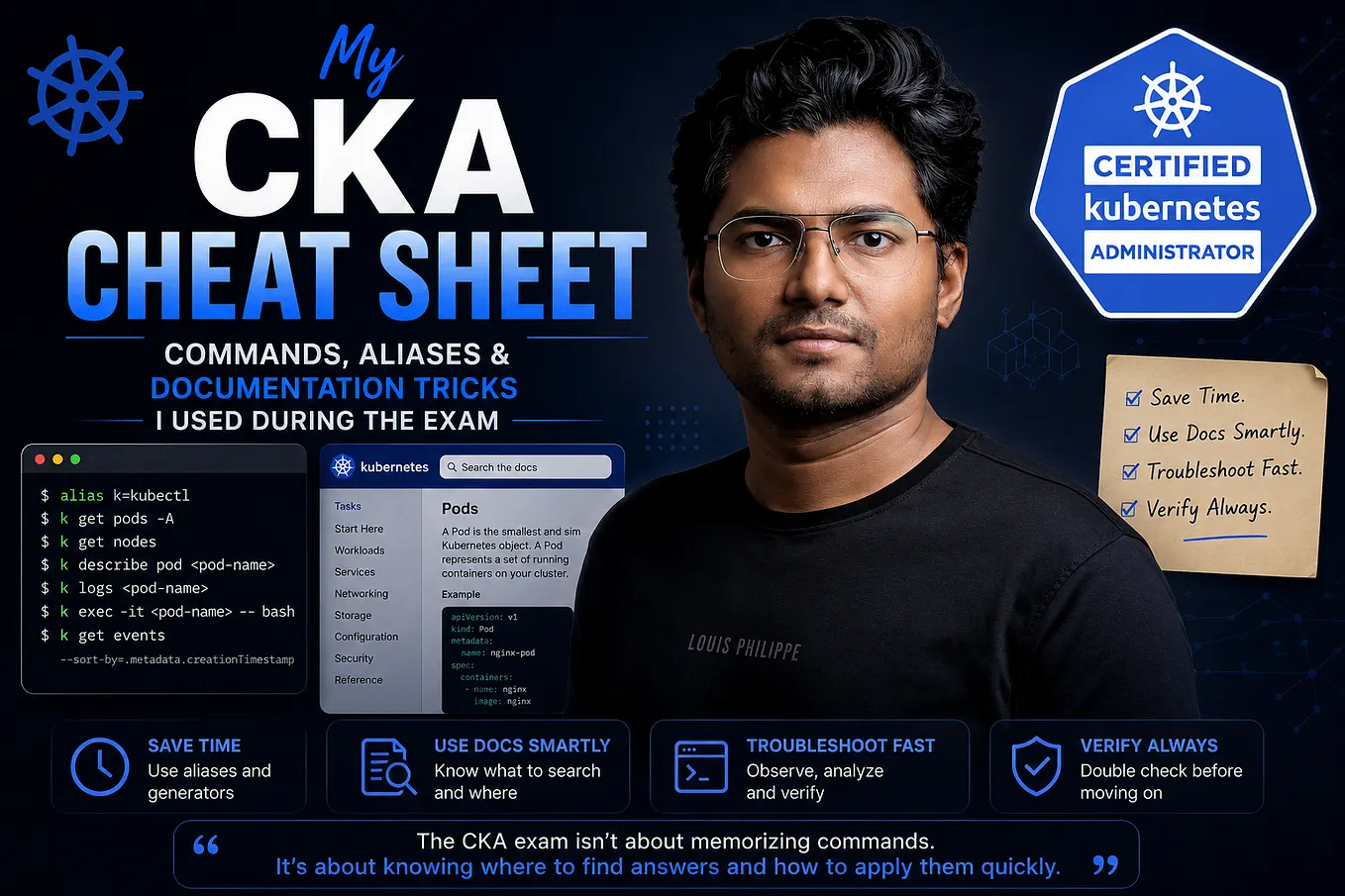
How I Used Kubernetes Documentation Effectively During the CKA Exam

One of the unique aspects of the Certified Kubernetes Administrator (CKA) exam is that Kubernetes documentation is allowed during the exam.
When I first learned this, I thought it would make the exam significantly easier.
However, after preparing for the exam and eventually passing it, I realized something important:
The CKA exam doesn’t test whether documentation is available. It tests how efficiently you can use it under pressure.
The difference between spending 30 seconds finding an answer and spending 5 minutes searching for it can determine whether you complete all the exam tasks on time.
In this article, I’ll share how I used Kubernetes documentation during my CKA preparation and exam, along with the techniques that helped me save valuable time.
Why Documentation Matters in CKA
The Kubernetes ecosystem is vast.
Even experienced administrators don’t memorize:
- Every YAML field
- Every kubectl option
- Every API version
- Every NetworkPolicy configuration
Instead, successful Kubernetes engineers know:
- Where to find information
- How to find it quickly
- How to adapt examples
That’s exactly how I approached the exam.
My Biggest Mistake Early in Preparation
When I started studying for CKA, I spent too much time trying to memorize commands and YAML syntax.
For example:
- Network Policies
- RBAC configurations
- Persistent Volume definitions
- Complex Pod specifications
Eventually, I realized I was using my study time inefficiently.
Instead of memorizing everything, I shifted my focus to:
- Understanding concepts
- Practicing kubectl
- Learning documentation navigation
That change made a huge difference.
Think Like an Administrator, Not a Student
In real-world environments, Kubernetes administrators rarely work from memory alone.
They:
- Read documentation
- Verify configurations
- Use examples
- Check references
The exam is designed to reflect that reality.
My goal wasn’t to memorize every YAML field.
My goal was to become efficient at finding what I needed.
The Documentation Sections I Used Most
During preparation, I frequently used the following areas of Kubernetes documentation.
1. Tasks Section
This became one of my favorite sections.
Examples:
- Creating Deployments
- ConfigMaps
- Secrets
- Network Policies
- Storage Configuration
The step-by-step examples are extremely useful.
2. kubectl Reference
Whenever I forgot command syntax, I used:
- kubectl create
- kubectl expose
- kubectl rollout
- kubectl drain
The reference section often provided exactly what I needed.
3. Concepts Section
I used this primarily for:
- Networking
- Storage
- Scheduling
- Security
When troubleshooting, understanding the concept is often more important than remembering a command.
4. API Resource Examples
Sometimes the fastest solution was finding an example YAML and modifying it.
Instead of creating everything from scratch, I could:
- Find a working example
- Copy the structure
- Adjust values
- Apply the configuration
This saved a lot of time.
My Documentation Navigation Strategy
One of the best habits I developed was practicing documentation usage during labs.
Whenever I practiced Kubernetes tasks, I forced myself to use documentation just like I would during the exam.
Get Shahzad Ali Ahmad’s stories in your inbox
Join Medium for free to get updates from this writer.
This improved:
- Search speed
- Navigation speed
- Familiarity with documentation layout
By exam day, I already knew where most topics were located.
Search Smarter, Not Harder
Many candidates waste time searching with broad keywords.
For example:
Instead of searching:
storageSearch:
persistent volume claim exampleInstead of:
rbacSearch:
rolebinding exampleThe more specific your search, the faster you’ll find relevant examples.
Documentation Is Not a Substitute for Practice
This is an important lesson.
Documentation can help you remember syntax.
It cannot replace hands-on experience.
If you don’t understand:
- Pods
- Deployments
- Services
- Networking
- Storage
Documentation won’t magically solve the problem during the exam.
That’s why I spent most of my preparation time:
- Practicing labs
- Troubleshooting clusters
- Working with kubectl
Documentation was simply an accelerator.
My Favorite Time-Saving Technique
When I needed YAML definitions, I rarely started from a blank file.
Instead, I often used:
kubectl create deployment nginx \
--image=nginx \
--dry-run=client \
-o yaml
Then I modified the generated output.
Combining generated YAML with documentation examples saved significant time.
Common Documentation Mistakes
1. Using Documentation for Every Question
If you need documentation for basic Pod creation, you’re not ready yet.
Documentation should support your knowledge — not replace it.
2. Reading Entire Pages
During the exam, you don’t have time to read entire articles.
Focus on:
- Examples
- Syntax
- Configuration snippets
3. Practicing Without Documentation
Many candidates avoid documentation during preparation.
I recommend the opposite.
Practice using documentation frequently so it feels natural on exam day.
What Helped Me Most
The most effective strategy was simple:
Learn
Understand the concept.
Practice
Perform the task.
Document
Find the official reference.
Repeat
Repeat until navigation becomes natural.
Eventually, documentation became a tool I could use confidently under pressure.
Final Thoughts
The Kubernetes documentation is one of the most powerful resources available during the CKA exam.
But simply having access to documentation is not enough.
The real skill is knowing:
- What to search for
- Where to search
- How to find examples quickly
- When to use documentation and when to rely on experience
For me, mastering documentation navigation was just as important as mastering kubectl commands.
And on exam day, those small efficiencies added up to valuable time savings.
If you’re preparing for CKA, don’t just study Kubernetes.
Study the documentation too.
Your future self will thank you.
Connect With Me
If you’re preparing for Kubernetes certifications, pursuing the Kubestronaut journey, or working in the cloud-native ecosystem, I’d love to connect.
Follow me on Medium for more articles on Kubernetes, CNCF certifications, DevOps, Platform Engineering, and Cloud-Native technologies.
LinkedIn: https://www.linkedin.com/in/shahzadaliahmad/
LFX Profile: https://openprofile.dev/profile/shahzadahmad91
Credly: https://www.credly.com/users/shahzadahmad
Website: https://shahzadahmad.dev/
If you found this article helpful, consider following, clapping, and sharing it with others in the Kubernetes community.