What Is Web Application Architecture?

When a company turns to custom web application development services, architecture is one of the first topics to discuss. It is the technical foundation that defines how every part of a web product connects, communicates, processes requests, and supports users during real interaction with the application.
In plain words, web application architecture describes the internal structure of a web app. It shows how the interface, backend logic, databases, APIs, middleware, security mechanisms, and external services work as one coordinated system. If this structure is planned well, the product can load quickly, process data correctly, withstand growing traffic, and evolve without painful technical limitations.
How Web Application Architecture Works
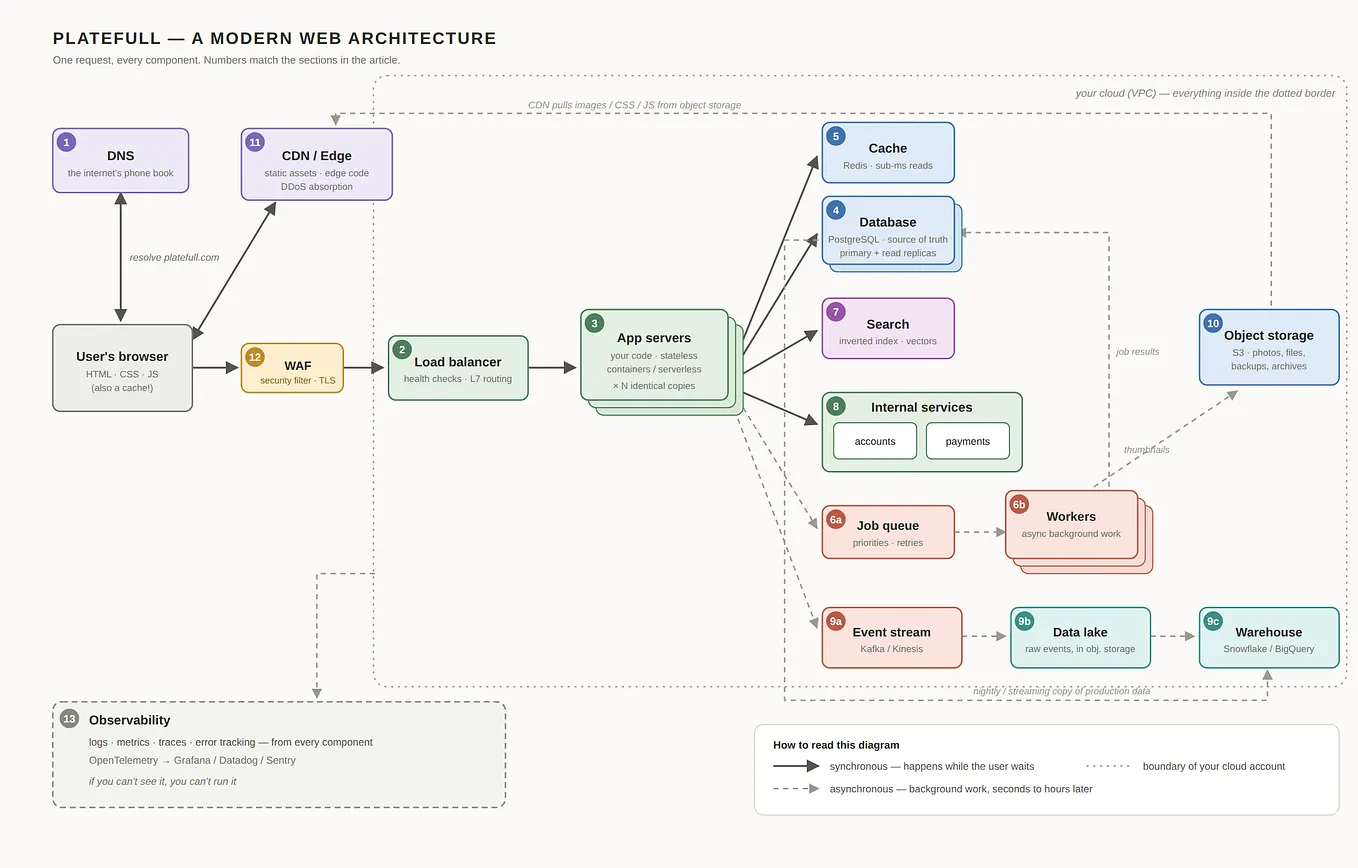
The process begins when a user interacts with a web application. This can be as simple as opening a page, entering a URL, clicking a button, filling out a form, signing in, or requesting certain information. The browser sends this action as a request to the server, and the server interprets it according to the application’s built-in rules and logic.
After receiving the request, the server may need to check user permissions, retrieve data from a database, process business logic, call an external API, or trigger another internal operation. Once everything is processed, the server sends the result back to the browser. The user then sees an updated page, a dashboard, a confirmation message, new data, or another expected response.
For the user, this chain should feel fast and seamless. They should not notice how many technical steps happen behind the interface. Yet this hidden layer is exactly what architecture is responsible for: routing requests, organizing data exchange, managing errors, securing access, and keeping the product available.
Cleveroad’s experience shows that this behind-the-scenes structure often directly impacts product quality. Even a visually simple web app may rely on user roles, admin tools, integrations, notifications, analytics, and future feature expansion. Without a solid architecture, these elements can become difficult to support as the product develops.
Core Components of Web Application Architecture
Most web application architectures consist of several connected parts. The client side is the part users see and interact with in their browser. It includes page layouts, buttons, forms, visual elements, and scripts that help the interface respond to user actions.
The server-side is responsible for the product’s main logic. It handles requests, manages authentication, processes operations, communicates with databases, and determines which information to send back to the client. Middleware can support this process by managing authorization, logging, caching, request handling, and error handling across the system’s layers.
The database stores the information the application needs to function. Depending on the product type, it may contain user profiles, orders, files, transactions, content, reports, analytics, operational data, or other important records. APIs enable the application to exchange data with external platforms, such as payment gateways, CRM systems, analytics services, cloud tools, enterprise software, mapping services, or industry-specific systems.
Get Cleveroad’s stories in your inbox
Join Medium for free to get updates from this writer.
In Cleveroad’s development practice, these parts are usually planned as one connected ecosystem. This helps ensure that the frontend, backend, database, integrations, and infrastructure all support the same product goals, rather than creating separate technical blocks that are hard to align later.
Why Architecture Matters for Web Applications
Architecture influences how a web application behaves after launch. A weak structure may lead to slow performance, unstable updates, security gaps, complicated maintenance, and higher development costs over time. A carefully planned structure, on the other hand, helps the application manage more users, support new features, and adapt to business changes with fewer risks.
This becomes especially important when a web product handles complex data, multiple user groups, third-party integrations, or business-critical workflows. From Cleveroad’s experience, such applications need more than an attractive interface. They require stable data flows, clear access control, scalable backend logic, and a technical foundation that allows new functionality to be added without disrupting the whole system.
Good architecture also makes future development more predictable. It improves code maintainability, simplifies testing, enables smoother deployment, and helps businesses avoid a situation in which every small product change becomes expensive or technically risky.
Modern Web Application Architecture in 2026
In 2026, web application architecture is usually created with future growth in mind. Many development teams use cloud-native infrastructure, microservices, containers, serverless functions, API-first design, and automated deployment pipelines. These approaches make it easier to update the product, scale individual parts of the system, and reduce the impact of technical failures.
For example, instead of creating a single large system in which all modules depend heavily on one another, businesses may opt for a more modular structure. In this model, separate services can be responsible for payments, user management, notifications, analytics, content, or other product functions. This gives the application greater flexibility and makes it easier to adapt as business requirements change.
Security also plays a much larger role than before. It should not be added only after the main features are finished. Access control, secure API communication, encryption, monitoring, and compliance-related requirements should be considered from the beginning of the architecture planning process.
Cleveroad’s experience confirms that architectural decisions should always align with business objectives. Some products can start with a simpler and more cost-efficient structure, while others need a more advanced architecture from the first release because they are expected to handle high traffic, sensitive data, complex workflows, or long-term scaling.
Final Thoughts
Web application architecture explains how a digital product works beneath the surface. It connects the client side, server side, databases, APIs, middleware, infrastructure, and security layers into one complete system. Its main purpose is to help every component communicate properly and deliver a stable user experience without delays, failures, or unnecessary risks.
For businesses, architecture is much more than a technical detail. It affects development cost, speed, performance, security, scalability, maintenance, and the ability to improve the product after launch. That is why architectural planning should happen before the active development phase begins.
From Cleveroad’s experience, a strong architectural foundation helps companies reduce development risks, launch with greater confidence, simplify future updates, and prepare their web applications for long-term growth. When the architecture reflects real business needs, the product becomes easier to maintain, scale, and improve over time.