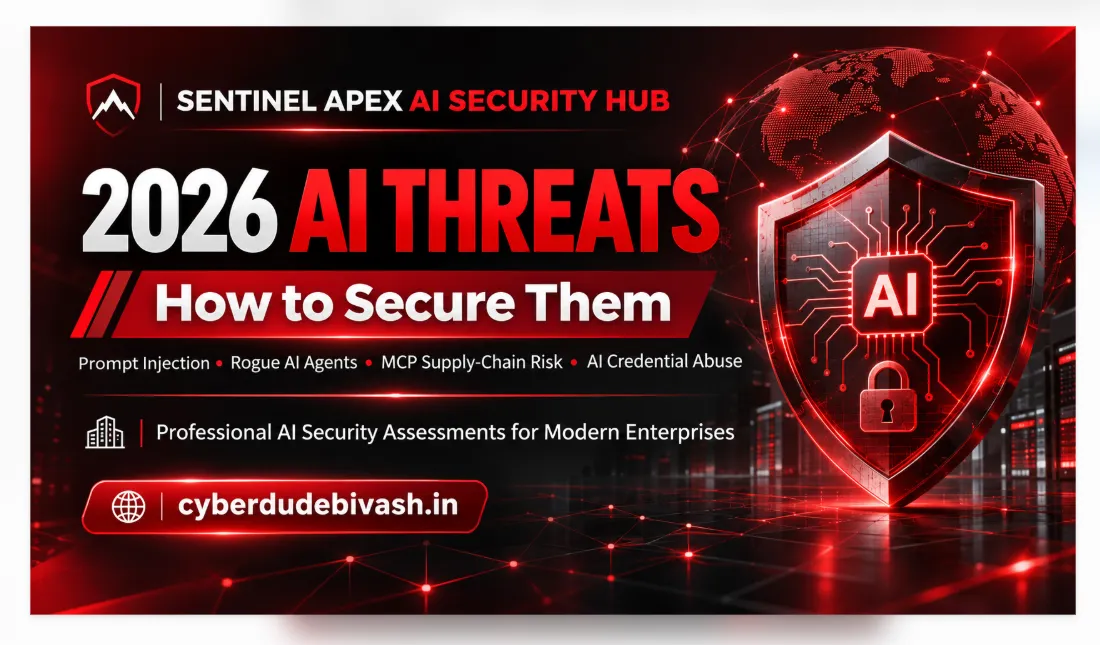
Enterprise AI Security, Threat Intelligence & SOC: The SENTINEL APEX Approach


How CYBERDUDEBIVASH® is bringing cyber threat intelligence, AI security assessments, detection engineering, security operations, governance, and practical cybersecurity tools into a connected security ecosystem.
By CYBERDUDEBIVASH® ECOSYSTEM | Cybersecurity, AI Security & Threat Intelligence
The Next Generation of Cybersecurity Needs More Than Another Security Dashboard
Modern enterprises are facing a difficult cybersecurity challenge.
They are deploying artificial intelligence, integrating large language models into business applications, connecting AI agents to enterprise systems, operating increasingly complex cloud infrastructure, and defending against adversaries who continuously adapt their techniques.
Yet many organizations still manage cybersecurity through disconnected tools and workflows.
Threat intelligence arrives in one system. Vulnerability findings appear in another. Identity risks are reviewed separately. Security alerts accumulate in the SIEM. Compliance evidence lives in spreadsheets. AI applications are released without consistent adversarial testing.
The result is not necessarily a shortage of security data.
It is a shortage of connected, actionable security decisions.
An effective security strategy must answer several fundamental questions:
- Which threats are relevant to our actual business assets?
- Which vulnerabilities deserve immediate remediation?
- Can our SOC detect the attack techniques that matter?
- Are our AI agents, LLM applications, and connected tools adequately protected?
- Can our security team convert intelligence into validated detections?
- Can we demonstrate security controls and remediation evidence to customers and auditors?
These are the challenges that inspired the development of the CYBERDUDEBIVASH® ECOSYSTEM and its SENTINEL APEX™ security portfolio.
Built in India with an international customer focus, the ecosystem brings together specialized platforms, intelligence resources, security tools, training, and professional services.
Explore the official ecosystem: https://www.cyberdudebivash.com/ecosystem
1. The Enterprise Security Gap: Intelligence Without Action
Cyber threat intelligence has genuine value only when it improves a decision.
Consider a security operations team receiving an advisory about a critical vulnerability.
A conventional workflow may stop at identifying the CVE and its CVSS severity.
An intelligence-driven workflow goes further.
The team investigates whether exploitation has been observed, whether vulnerable technology exists in its environment, which adversary techniques are relevant, what telemetry is available, and what containment or remediation actions are justified.
That requires several disciplines working together.
Cyber Threat Intelligence (CTI) provides context about threats, vulnerabilities, indicators, actors, and techniques.
Security Operations (SOC) investigates telemetry, triages alerts, validates threats, and coordinates incident response.
Detection Engineering converts attack behaviors into testable detection logic.
AI Security evaluates the additional risks created by AI applications, agents, models, integrations, and data flows.
Security Governance establishes accountability, evidence, risk ownership, and operational controls.
The most effective security programmes connect these disciplines instead of treating them as isolated projects.
A seven-stage intelligence-to-action operating model
A practical architecture looks like this:
Stage 1 — Discover: Identify relevant vulnerabilities, indicators, suspicious activity, AI-system risks, and exposed assets.
Stage 2 — Validate: Verify source attribution, timestamps, supporting evidence, data quality, and known limitations.
Stage 3 — Prioritize: Evaluate exploitability, business exposure, asset criticality, observed exploitation, and operational impact.
Stage 4 — Correlate: Map intelligence to known adversary techniques, relevant systems, identities, and telemetry.
Stage 5 — Detect: Develop and test SIEM detection rules, hunting queries, and response playbooks.
Stage 6 — Respond: Investigate findings, assign ownership, document decisions, and execute authorized remediation.
Stage 7 — Demonstrate: Preserve evidence, measure control effectiveness, and communicate residual risk.
This operating model is useful whether an organization has a dedicated SOC, an outsourced security provider, or a small internal security team.
It also provides a practical way to evaluate cybersecurity technology: Does the tool improve the decision chain, or merely create another dashboard?
2. SENTINEL APEX™ Threat Intelligence: Turning Threat Data Into SOC Context
Explore SENTINEL APEX Threat Intelligence
Threat intelligence is one of the foundational capabilities in the CYBERDUDEBIVASH® portfolio.
SENTINEL APEX™ is positioned for security analysts, threat intelligence professionals, security operations teams, and managed security service providers that need structured intelligence they can investigate and integrate into existing workflows.
Its published platform capabilities include:
- Threat advisories with source-linked context
- Indicators of compromise, including IP addresses, domains, and hashes
- MITRE ATT&CK® technique mapping
- STIX 2.1 intelligence bundles
- EPSS-enriched vulnerability context
- Detection engineering resources, including Sigma and KQL
- REST API access, with capabilities and limits determined by plan
Why contextual intelligence matters
A CVSS score describes the severity characteristics of a vulnerability. It does not independently establish the likelihood that attackers will exploit that issue against a particular organization.
Security teams can strengthen prioritization by considering resources such as the CISA Known Exploited Vulnerabilities catalogue and FIRST’s Exploit Prediction Scoring System.
These signals should be combined with asset exposure, business impact, compensating controls, and observed local activity.
The objective is to separate high-priority operational risk from the general background volume of vulnerability information.
For an MSSP, machine-readable feeds can support repeatable intelligence ingestion across authorized customer environments.
For an enterprise SOC, structured intelligence can improve investigation consistency and detection-development workflows.
For a security researcher, source attribution and evidence quality support more defensible analysis.
SENTINEL APEX offers a Community entry point alongside paid plans for more extensive platform access. Feature entitlements, API limits, exports, and contractual service terms should be checked against the current published plan.
Explore Threat Intelligence Plans and Capabilities
3. SENTINEL APEX AI SECURITY HUB™: Addressing the Security Risks of Enterprise AI
Artificial intelligence is becoming part of enterprise application infrastructure.
An AI assistant may retrieve internal documents. An autonomous agent may call external APIs. A retrieval-augmented generation application may combine sensitive organizational data with external information.
These integrations create security responsibilities beyond conventional endpoint and network protection.
Organizations must evaluate the trust boundaries between models, prompts, retrieved content, tools, identities, secrets, and business-critical systems.
What should an enterprise AI security assessment examine?
Prompt injection and instruction manipulation
Can untrusted content influence the behavior of an AI application or cause it to operate outside its intended instructions?
Sensitive-data exposure
Can the application reveal confidential material through responses, retrieved documents, logs, or improperly controlled integrations?
Agent and tool permissions
Can an AI agent access more information or perform more actions than its business purpose requires?
Model and application supply-chain risk
Are model dependencies, application components, tool integrations, datasets, and third-party services appropriately governed?
Authentication and authorization
Do users, agents, service accounts, and tools operate with least-privilege permissions?
Monitoring and accountability
Can the organization reconstruct important agent actions, investigate unexpected behavior, and demonstrate appropriate oversight?
These questions matter to software vendors, financial institutions, healthcare technology teams, SaaS providers, enterprises deploying internal copilots, and organizations integrating AI into sensitive workflows.
The AI Security Hub’s role
The published SENTINEL APEX AI SECURITY HUB portfolio describes capabilities and service areas relating to security scanning, AI-agent and MCP security, exposure assessment, governance, security analysis, and reporting.
For enterprise buyers, the most useful starting point is a clearly scoped evaluation.
Identify the systems to be assessed, the expected evidence, the permissions required, and the specific capabilities to demonstrate.
A meaningful AI security assessment should produce actionable findings, not simply a label describing an application as secure or insecure.
Security outcomes must be validated against the customer’s environment, requirements, and authorized test scope.
Explore the platform: https://www.cyberdudebivash.in/
4. SOC Operations and Detection Engineering: From Alerts to Defensible Decisions
A modern Security Operations Center needs more than high-volume alert collection.
It needs workflows that help analysts determine which events deserve attention, what the supporting evidence shows, and how the organization should respond.
A strong SOC engineering programme connects threat intelligence with telemetry, detection logic, case management, analyst review, and remediation.
Detection engineering as a measurable security discipline
Consider a suspected credential-compromise incident.
A properly designed detection workflow would investigate authentication activity, account privilege, session characteristics, available endpoint or identity telemetry, and known suspicious behaviors.
The engineering process should determine:
- What behavior must be detected?
- Which log sources provide the necessary evidence?
- Which conditions distinguish suspicious activity from normal operations?
- How will the detection be tested before release?
- How will false positives, rule changes, and failures be reviewed?
- What documented response should follow a validated alert?
This approach makes detection engineering measurable.
SENTINEL APEX’s research and SOC-readiness surface provides an intelligence-oriented workflow covering triage, investigation, threat hunting, detection engineering, customer access, and assurance review.
Explore SENTINEL APEX Security Intelligence and SOC Readiness
CYBERDUDEBIVASH® also lists professional services for detection engineering, security automation, managed SOC support, incident response, and related security operations.
Managed coverage periods, response commitments, connected log sources, supported integrations, and service-level agreements are established through the relevant engagement scope and written agreement.
Explore Enterprise Cybersecurity Services
5. AI Red Teaming, Security Assessments, and Adversarial Validation
Traditional vulnerability scanning is useful, but security controls also need to be evaluated against realistic, authorized adversarial scenarios.
This is especially important for AI-enabled applications.
An AI red-team engagement can investigate how untrusted instructions, excessive privileges, unsafe tool calls, retrieval content, or insecure application components might affect system behavior.
The goal is to uncover meaningful security weaknesses and provide engineering teams with practical remediation guidance.
What enterprises should expect from a professional assessment
A well-governed assessment begins with an agreed scope and written authorization.
It should define the systems under review, permitted testing methods, data-handling restrictions, escalation procedures, and expected deliverables.
A useful final report should distinguish verified findings from hypotheses and include supporting evidence, business impact, remediation guidance, and opportunities for retesting.
CYBERDUDEBIVASH® lists cybersecurity assessment and professional service offerings covering areas such as:
- AI and LLM application security
- Authorized penetration testing
- AI security assessments and red-team exercises
- Security architecture review
- Vulnerability validation and remediation planning
- Detection engineering and security automation
- Incident response and digital forensics
Services are scoped according to the customer’s systems, requirements, and contractual arrangements.
Get CYBERDUDEBIVASH® | AI & Cybersecurity Ecosystem’s stories in your inbox
Join Medium for free to get updates from this writer.
Enterprise security testing must always be authorized by the system owner.
View the service catalogue: https://www.cyberdudebivash.com/services
6. Security Governance, SOC 2 Readiness, and AI Risk Management
Cybersecurity is also a governance responsibility.
Security leaders increasingly need to explain technical risk to business stakeholders, define control ownership, maintain evidence, and prepare for customer security assessments.
For organizations deploying AI, this can include AI-specific policies, model and application inventories, human oversight, third-party risk, and incident escalation procedures.
Useful reference frameworks include:
NIST AI Risk Management Framework: https://www.nist.gov/itl/ai-risk-management-framework
MITRE ATT&CK: https://attack.mitre.org/
OWASP GenAI Security Project: https://genai.owasp.org/
FIRST EPSS: https://www.first.org/epss/
These resources help security teams build repeatable assessment methodologies.
From compliance documents to security evidence
A governance programme becomes more credible when it can demonstrate real control operation.
Examples include approved access reviews, risk assessments, change records, incident exercises, detection validation, vulnerability remediation evidence, and management decisions.
CYBERDUDEBIVASH® offers professional service categories covering compliance readiness, risk assessment, security advisory, and governance support.
Its published portfolio references frameworks and requirements including SOC 2, ISO/IEC 27001, NIST AI RMF, and India’s Digital Personal Data Protection framework.
Important distinction: Readiness assessments, control mapping, and SOC 2-aligned engineering do not constitute SOC 2 attestation, ISO certification, regulatory approval, or a guarantee of legal compliance.
The appropriate outcome is an evidence-based understanding of control maturity, gaps, ownership, and required corrective actions.
Discuss Security Governance and Compliance Readiness
7. Security Tools, Licensed Products, and Hands-On Labs
Not every organization needs another hosted subscription.
Security engineering teams often need a targeted tool that can operate in their own infrastructure, fit their existing workflows, or support hands-on evaluation.
The CYBERDUDEBIVASH® portfolio includes security tooling and licensed products across multiple technical disciplines.
Explore CYBERDUDEBIVASH Security Tools
The tools catalogue covers categories such as AI and LLM security, detection engineering, cloud security, identity security, governance, infrastructure, and defensive security utilities.
The SENTINEL APEX Labs and Store provides another entry point for exploring licensed security tools and evaluation environments.
Visit SENTINEL APEX Labs and Store
What should buyers validate before acquiring a security tool?
Technical teams should examine the deployment model, supported operating systems, runtime dependencies, source-code or licensing terms, available documentation, support arrangements, maintenance expectations, and data-processing behavior.
Where an evaluation lab is available, it should be used to test the specific customer use case.
Self-hosted software can offer deployment flexibility, but the customer remains responsible for securing its operating environment unless a separate managed arrangement explicitly covers those responsibilities.
The most valuable security product is not necessarily the one with the longest feature list.
It is the one that solves a real operational problem, produces useful evidence, and can be maintained responsibly.
8. TRUSTX™: Identity Threat Detection and Response
Identity security is another important part of enterprise defense.
Compromised accounts, excessive privileges, suspicious sessions, and poorly governed service identities can create serious security exposure.
This becomes especially relevant when AI applications and automation platforms depend on service accounts, delegated permissions, or enterprise identity providers.
TRUSTX™ is an identity threat detection and response initiative within the CYBERDUDEBIVASH® ecosystem.
Its published scope includes account-takeover defense, privileged identity security, suspicious-session analytics, and Microsoft Entra-related integration work.
TRUSTX is identified as a private-preview/early-access offering. Organizations interested in evaluation should confirm supported features, integration readiness, and onboarding arrangements before procurement.
Explore TRUSTX Identity Security
9. SENTINEL APEX Academy: Developing the People Behind Security Operations
Technology alone does not create an effective cybersecurity programme.
Organizations also need analysts, developers, architects, and security leaders who understand how to evaluate threats, investigate evidence, implement controls, and make sound decisions.
SENTINEL APEX Academy focuses on learning pathways across cybersecurity, artificial intelligence security, threat intelligence, SOC operations, and DevSecOps.
The Academy provides an entry point for individuals building professional skills and organizations exploring structured team development.
Training programmes should be evaluated based on their published curriculum, practical exercises, assessments, and support terms.
Course completion should not be confused with an independent industry certification unless a particular programme explicitly provides one.
10. Three Practical Enterprise Use Cases
How might an organization apply this portfolio to real security challenges?
Use case A: A SOC facing vulnerability overload
Business problem: A security team receives large volumes of vulnerability advisories but lacks a consistent way to determine urgency.
Recommended approach: Use source-attributed threat intelligence, exploitation context, asset criticality, and vulnerability prioritization to establish a defensible remediation queue.
Relevant capabilities: SENTINEL APEX Threat Intelligence, threat research, API-based intelligence integration, and detection engineering.
Desired business outcome: Better-informed remediation decisions, reduced analytical duplication, and evidence that critical issues were reviewed.
Use case B: A SaaS organization deploying enterprise AI agents
Business problem: A software provider plans to connect an AI agent to customer information, internal business systems, and external tools.
Recommended approach: Establish an agent inventory, map permissions and trust boundaries, perform authorized adversarial testing, define monitoring requirements, and document remediation ownership.
Relevant capabilities: SENTINEL APEX AI SECURITY HUB, AI Security Assessment services, AI governance resources, and identity-security evaluation.
Desired business outcome: Greater visibility into AI application risk and a structured process for addressing identified weaknesses before broader deployment.
Use case C: A growing enterprise preparing for customer security reviews
Business problem: An enterprise buyer requests evidence about security operations, access controls, vulnerability management, and governance.
Recommended approach: Assess existing controls, identify evidence gaps, establish action owners, and develop a realistic improvement plan.
Relevant capabilities: Governance and compliance readiness services, detection engineering, security advisory, and practical staff training.
Desired business outcome: A more organized security assurance process and a clearer view of outstanding control requirements.
These examples illustrate evaluation pathways, not guarantees of specific results.
11. Choosing an Enterprise Cybersecurity Platform: A Practical Buyer’s Checklist
Before adopting a cybersecurity platform or service, ask questions that go beyond marketing claims.
Security effectiveness: Can the provider demonstrate a representative workflow with authentic, inspectable outputs?
Integration: What APIs, formats, authentication models, and telemetry integrations are supported?
Operational transparency: Are data freshness, data sources, known limitations, and service boundaries documented?
AI-specific safeguards: How are model inputs, agent permissions, sensitive data, and high-risk actions controlled?
Trust and governance: What security and compliance evidence can the provider substantiate?
Commercial clarity: Which features are available today, which require a paid plan, and which are offered only through a scoped engagement?
Implementation: Who owns deployment, incident handling, maintenance, integrations, and ongoing operational costs?
Support: Which response commitments are contractually included?
A credible security provider should be willing to discuss these questions openly.
For specialized security programmes, a smaller but well-defined implementation can be more valuable than a broad deployment whose operating assumptions have never been tested.
12. Built in India. Designed for International Security Challenges.
Cybersecurity is a global discipline.
Threat actors, technology dependencies, enterprise supply chains, and software vulnerabilities do not respect geographic boundaries.
CYBERDUDEBIVASH® is building its cybersecurity ecosystem from Odisha, India, with platforms, products, training resources, and professional service offerings intended for a broader international audience.
The strategic idea is straightforward:
Connect cybersecurity intelligence, security engineering, AI risk management, and practical security capability development around identifiable customer problems.
That means offering different entry points for different needs.
A threat intelligence analyst may begin with the SENTINEL APEX Community platform.
An AI engineering team may seek a scoped AI security assessment.
A SOC team may evaluate detection engineering resources.
A compliance leader may need security governance and readiness support.
A cybersecurity practitioner may need a specific licensed tool or structured training.
These are different buying journeys, but they share one principle: security technology should contribute to measurable, accountable decisions.
13. Frequently Asked Questions
What is SENTINEL APEX?
SENTINEL APEX is a cybersecurity platform and product family associated with CYBERDUDEBIVASH®, covering cyber threat intelligence, AI security, security operations, and related security resources.
Does SENTINEL APEX provide a cyber threat intelligence API?
The published threat intelligence platform includes REST API access and machine-readable intelligence capabilities. Usage limits and available outputs depend on the selected plan.
Visit https://intel.cyberdudebivash.com/ for current details.
Can enterprises request AI security assessments or red teaming?
CYBERDUDEBIVASH® lists AI security assessments and authorized adversarial security-testing services. The systems, methods, deliverables, and commercial terms must be agreed in a written engagement scope.
Does CYBERDUDEBIVASH offer SOC services?
Its enterprise services catalogue includes managed SOC and detection engineering offerings. Operational coverage, connected systems, and SLAs are determined by the relevant proposal and contract.
Is SENTINEL APEX SOC 2 certified?
SOC 2-aligned engineering and readiness activity should not be interpreted as a SOC 2 attestation. Customers should request current, verifiable assurance documentation and confirm the exact scope of any independently audited claims.
Can security teams evaluate tools before purchasing?
Selected tools are presented with evaluation options through the ecosystem’s Labs and Store. Availability, licence conditions, and supported deployment environments should be checked on the individual product page.
Is TRUSTX generally available?
The official portfolio currently identifies TRUSTX as private preview or early access. Prospective customers should request confirmation of onboarding and supported integrations.
How can enterprises engage CYBERDUDEBIVASH?
Organizations can explore the public platforms, review the official ecosystem directory, and contact the team for product evaluation, commercial questions, or a scoped security proposal.
14. Your Next Step: Convert Security Complexity Into an Actionable Programme
There is no single product that eliminates every cybersecurity risk.
Strong enterprise security depends on accurate intelligence, effective engineering, appropriate governance, skilled people, and operational verification.
The CYBERDUDEBIVASH® ECOSYSTEM brings together specialized platforms and services for organizations exploring this approach.
Whether your immediate priority is cyber threat intelligence, AI security assessment, SOC detection engineering, compliance readiness, identity security, or hands-on cybersecurity tooling, start with a clearly defined business problem and an evaluation plan.
Explore the SENTINEL APEX ecosystem and choose the capability that matches your next security decision.
Official ecosystem: https://www.cyberdudebivash.com/ecosystem
Threat Intelligence: https://intel.cyberdudebivash.com/
AI Security Hub: https://www.cyberdudebivash.in/
Enterprise Services: https://www.cyberdudebivash.com/services
Security Tools: https://tools.cyberdudebivash.com/
Labs and Store: https://labs.cyberdudebivash.in/
Academy: https://academy.cyberdudebivash.com/
Pricing and Plans: https://www.cyberdudebivash.com/pricing
Enterprise enquiries and proposals: https://www.cyberdudebivash.com/contact
CYBERDUDEBIVASH® ECOSYSTEM
AI Security | Cyber Threat Intelligence | SOC Engineering | Security Assessments | Governance | Security Tools | Professional Training
Built in Odisha, India. Serving an international cybersecurity community.
Editorial note: Product descriptions reflect the publicly listed portfolio. Features, availability, commercial terms, and service commitments should be verified against the current official offering and written agreement before procurement.