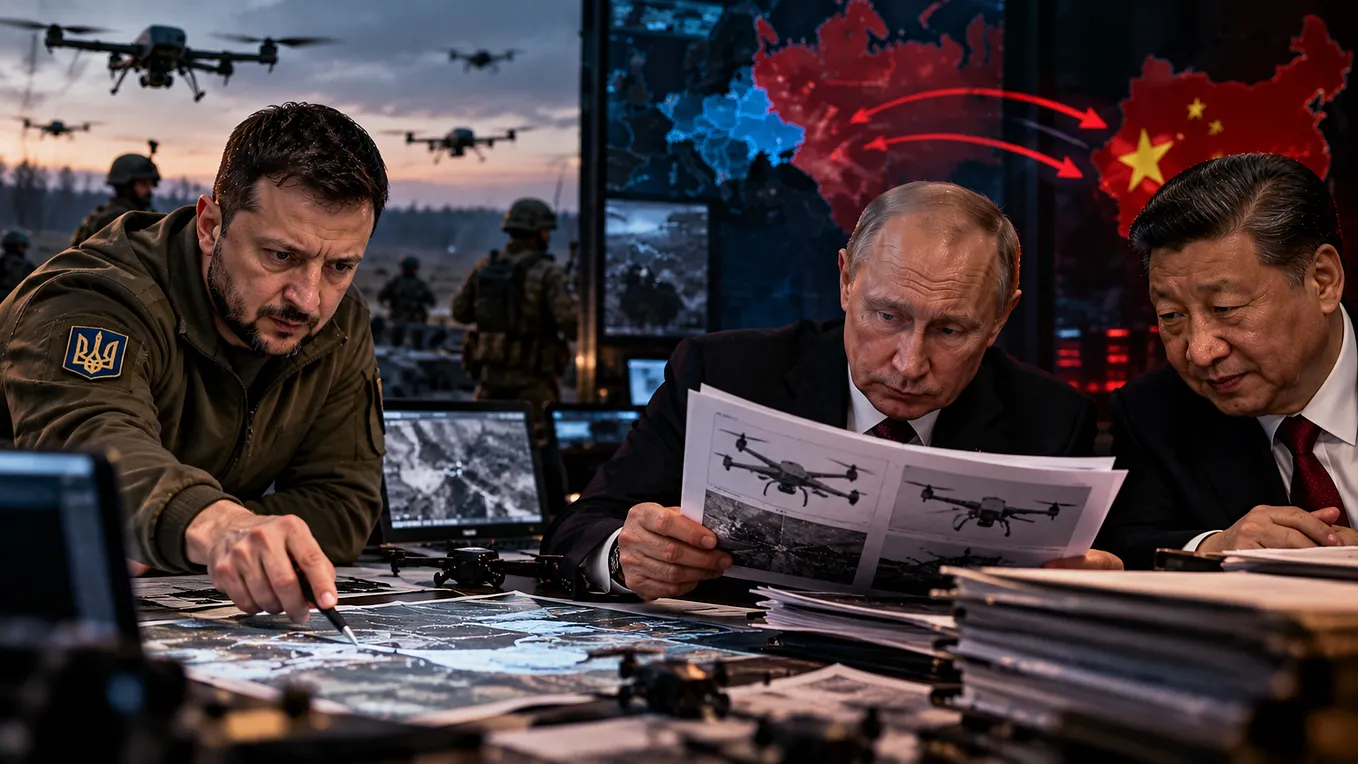
Russia Is Bleeding at a Record Rate. Ukraine Went Underground.


On Tuesday, Donald Trump told reporters that Ukraine can’t stop Russian attacks and that Russia’s manpower is effectively bottomless.
Two mornings later, Ukraine’s General Staff published its daily count. Between October 21 and 22, Russian forces lost at least 2,250 men killed or seriously wounded. That is the highest single-day figure of the entire war, breaking a record of 2,200 that had stood since December 2024. The highest figure of 2026 before this week had been 2,100, on October 18.
These are Ukrainian figures, and Moscow says Kyiv inflates them. But Ukrainian units say much of what they count is recorded live by drones, and some of that footage is published. Even if you shave a chunk off the totals, the trend is hard to argue with.
How You Lose 2,250 Soldiers in a Day?
Ukrainian sources describe the same pattern again and again. The Azov Corps, which commands the sector, says Russia’s preferred approach is to send small groups of infantry on foot across open fields, hoping a few will slip into Ukrainian positions and dig in. Ukrainian milbloggers believe the record day came from heavy assaults aimed at breaking into Dobropillya.
The problem for Russia is that those fields are watched. Major Robert Brovdi, commander of Ukraine’s drone forces, said his pilots killed 680 Russian soldiers with FPV and bomber drones in that same 24-hour window, a record for his service. Brigadier General Ihor Oboliensky of the Khartiia Corps said irreversible losses in some sectors have reached as high as 74 percent.
Let me do some rough arithmetic with this, because the monthly picture matters more than any single day. Ukrainian analyst Vasyl Pekhno estimated that Russia’s losses for October had reached 35,950 by around the 22nd. That’s roughly 1,600 a day. Keep that pace for the rest of the month and October lands somewhere around 50,000.
Now set that beside September. Earlier this month, Bloomberg cited a NATO official saying Russia lost more than 50,000 soldiers in September. If October comes in at a similar number, that is two consecutive months at a level Pekhno believes exceeds what Russia can recruit or conscript to replace.
I want to be careful here. Pekhno’s estimate is one analyst’s projection built on Ukrainian data, and the September figure comes from a single anonymous official. But the two point the same way, and the record daily counts point the same way too.
This is what attrition looks like when one side has the drones and the other has the bodies.
None of it means Russia is about to collapse. It still holds about a fifth of Ukraine, and it is still throwing missiles and glide bombs at Ukrainian cities every night. On Friday, FAB-250 bombs hit Kramatorsk, killing one person and wounding six, including a seven-year-old, a ten-year-old and their toddler brother. But the story Trump keeps telling about a Russian steamroller and a Ukrainian army that can’t hold doesn’t match what is happening on the ground.
And then there is Kupiansk.
For two years, Russian troops have crawled through gas pipelines to get behind Ukrainian lines. They did it at Avdiivka. They did it near Sudzha during Ukraine’s Kursk incursion. They did it at Kupiansk, where an old Soviet gas line runs under the Oskil River. Ukrainian commanders say Russia has even used specialist troops, likely former miners, for these operations.
Get Evan Ray’s stories in your inbox
Join Medium for free to get updates from this writer.
This week, Ukraine turned the tactic around.
The National Guard’s 2nd Khartiia Corps says that in an operation code-named Veles, its troops moved more than 15 kilometres through underground infrastructure and came out behind Russian lines near Kupiansk. They did it with no GPS, no daylight and no reliable radio. Above ground, other units advanced at the same time, with strikes from the 429th Achilles drone brigade coordinated through a joint centre. The idea was to hit Russian troops from the front and the rear at once. The corps says more than 30 Russians were captured and Russian losses topped 100.
Oboliensky’s line about it is worth quoting: “We studied their experience, outplayed them on their own ground.”
Two caveats. The 15 kilometres refers to the underground route, not to how far the front line moved. And the figures come from Khartiia’s own press release, which hasn’t been independently verified. Even so, the operation tells you something about how Ukraine is fighting now. It isn’t trying to smash through with big armoured columns. It is picking apart Russian positions with drones, small units and surprise, much as it did at Lyman.
There’s also a delicious detail in the order of battle. Units from Ukraine’s military intelligence took part, including the Freedom of Russia Legion and the Russian Volunteer Corps. So Russians, fighting for Ukraine, crawled through a Soviet-built pipe to ambush Russian soldiers who had been using that same trick against Ukraine. Veles, for the record, is the Slavic god of the underworld. Someone in Khartiia has a sense of humour.
ISW also reported this week that Ukrainian forces advanced west of Kostyantynivka. A few days earlier, it noted gains in the Lyman area, east of Dobropillya and in western Zaporizhzhia. None of these is a breakthrough. But the gains keep coming in small pieces, in different places, while Russia pays record prices for ground it mostly isn’t taking.
That brings us to the negotiating table, where the gap between the two sides is now very clear.
Zelensky told ABC News that Ukraine is ready to end the war quickly by freezing the front line where it is. He also corrected a number that keeps creeping into the coverage. Russia controls 19.3 percent of Ukraine, he said, not 25. The 25 figure only works if Ukraine hands over the rest of Donbas, which it won’t. And Kyiv will never legally recognise occupied land as Russian.
At the Hudson Institute on Friday, he set out what a lasting armistice would need: a ceasefire first, binding allied commitments, and long-term money for Ukraine’s military. “We need a big, big strong army, minimum ten years,” he said. He also asked the question nobody in the West has answered yet: if Russia attacks again after a deal, who exactly responds, and how?
Now compare that with Moscow. The same day, ISW reported that Putin had again invoked false “historical claims” to territory far beyond Donetsk Oblast. A day earlier, ISW assessed that the Kremlin’s apparent interest in talks is really about winning economic concessions from Washington so it can keep funding the war.
Read those side by side. Kyiv is offering to stop where the guns are. Moscow is still talking about land it doesn’t hold and money it hasn’t got.
My reading, and it is only that, is that Putin needs time more than he needs territory right now. He needs relief for Rosneft, buyers for his diesel, and a pause for an army losing 50,000 men a month. Talks, the diesel deal and any easing of sanctions all buy him that time. The record losses on the battlefield are exactly why he wants it.
Zelensky says three-way talks with Russia and the United States could happen in Abu Dhabi in early or mid-November, if the Kremlin shows up. Moscow derailed a planned October meeting with procedural objections.
There was one piece of genuinely good news this week. Melania Trump said she had brokered a localized ceasefire in occupied Oleshky in Kherson Oblast, where civilians have been trapped with scarce food and medicine. Residents will be allowed to evacuate to either Ukraine or Russia. Russian forces declared a silence regime from 27 October; the White House said the US-brokered deal would take effect on 29 October. Any evacuation that gets people out is worth having.
But a ceasefire in one town for one humanitarian purpose isn’t a peace process. The record casualty counts and the bombs on Kramatorsk show what the rest of the front still looks like.
“Of course, we are not losing this war,” Zelensky said in Oslo this week. “But we are losing people.”