Keep the work, Change the Recipe (Post 4)

What fidelity means when context changes

The first three posts in this series have complicated what initially looked like a fairly simple idea.
In Miso Is Salt Too, I used Samin Nosrat’s Salt Fat Acid Heat to explore what it means to learn principles rather than simply reproduce recipes — without fully dismissing the value of recipes. Many ingredients can add saltiness to a dish.
In Equivalent for What?, I argued that different arrangements (apples and oranges) can sometimes be meaningfully compared because they perform a sufficiently comparable causal job within a specified and bounded pathway.
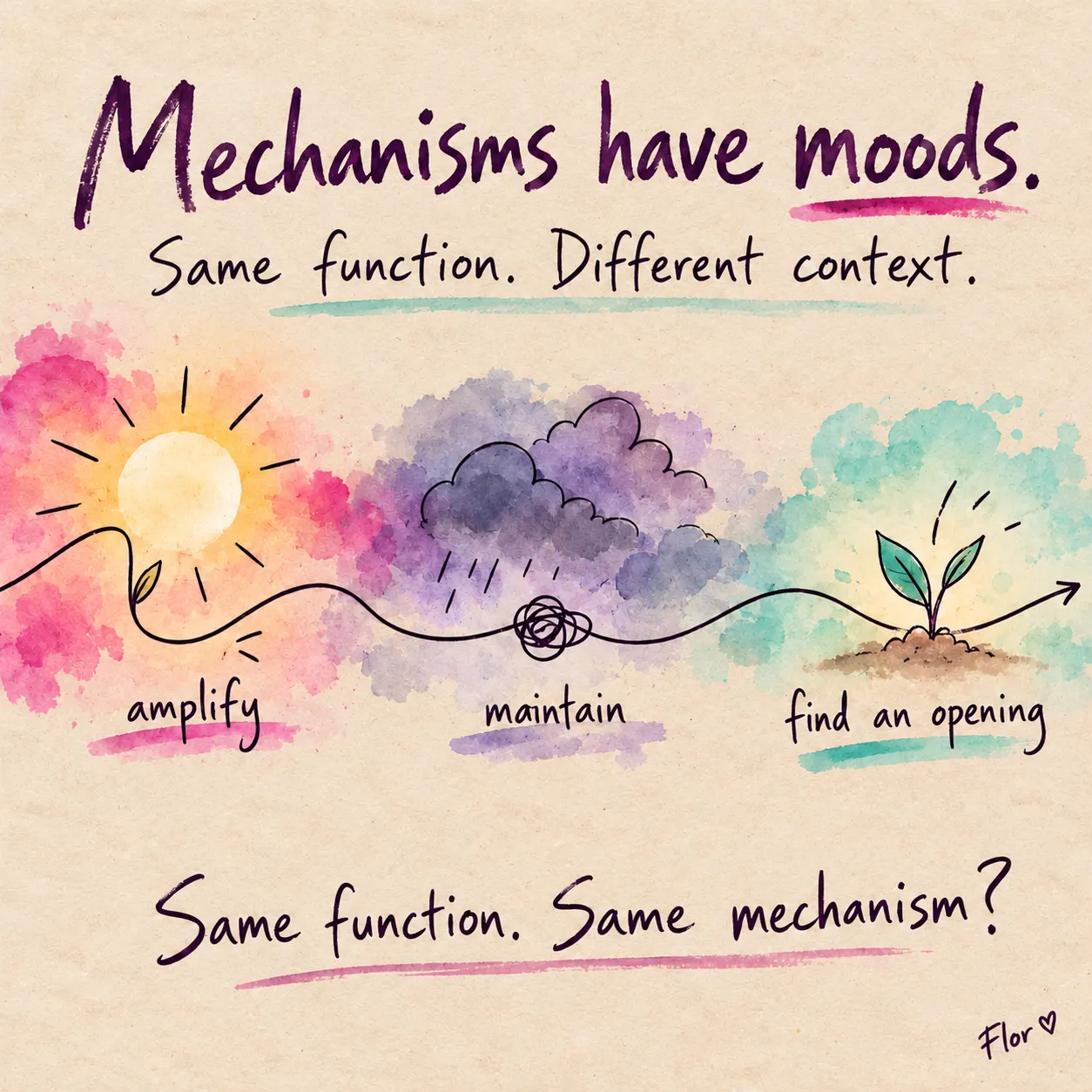
Then, in Mechanisms Have Moods, I complicated that proposition further. A comparable function does not mean that the same mechanism will activate in the same way everywhere — or even in the same place over time. Political mood, relationships, authority, incentives and perceptions of what is possible, for example, can all change what an intervention sets in motion.
So what exactly should remain stable when an intervention adapts?
A conventional answer is the model.
The more useful evaluative answer, often, is more discriminating than the model:
The causal work that still matters — and enough evidence to know whether it is actually being preserved, recreated or deliberately revised.
This is where Nosrat’s distinction between learning a recipe and learning how a dish works becomes useful again. If you understand what an ingredient is contributing, you have more room to substitute, adjust or rebalance without losing the dish. But that freedom depends on understanding the function well enough to know what cannot simply be changed.
That changes what fidelity means.
When copying the intervention loses the intervention
Imagine that the most visible component of a successful program is a monthly multistakeholder meeting.
The meeting worked in the original setting because a respected official consistently attended. A trusted facilitator could translate politically sensitive disagreements into administratively actionable proposals. Participants already had enough relational history to disagree without walking away. And what emerged from the meeting had a route into an actual decision process.
Now replicate the model somewhere else. Same monthly meeting. Same stakeholder categories. Same facilitation guide. Same reporting template. Perhaps even the same indicators.
Yet this time nobody in the room can authorize anything. Participants contribute information, but it has nowhere to travel. The facilitator manages the conversation but lacks the relationships needed to broker disagreement. The meeting continues to produce outputs while becoming increasingly detached from consequential decisions.
The form has been replicated. Much of the causal work has not.
A recent reflection from BRAC International on graduation programs offers another example. Two households can receive the same asset, cash support and training, while the quality of the relationship with the coach differs substantially. The visible program architecture remains recognizable. What may not travel so easily is the time, trust, listening and judgment through which a coach comes to understand a household well enough to adapt support around its circumstances. As the authors note: a program can still look intact on the dashboard while some of the relational infrastructure through which it works is thinning. Scale can reproduce the package more easily than the causal work embedded in relationships.
This problem has a methodological history
These are live examples of an older methodological problem — in previous posts I provided entry points via comparative politics research. Research on complex interventions also challenges the assumption that standardization requires identical components across settings, arguing that function and process might remain consistent while their concrete manifestation varies. Implementation researchers make the distinction more explicit through the language of core functions and forms, distinguishing the purposes an intervention needs to fulfil from the concrete strategies used to enact them. More recently, I came across another useful term: function fidelity.
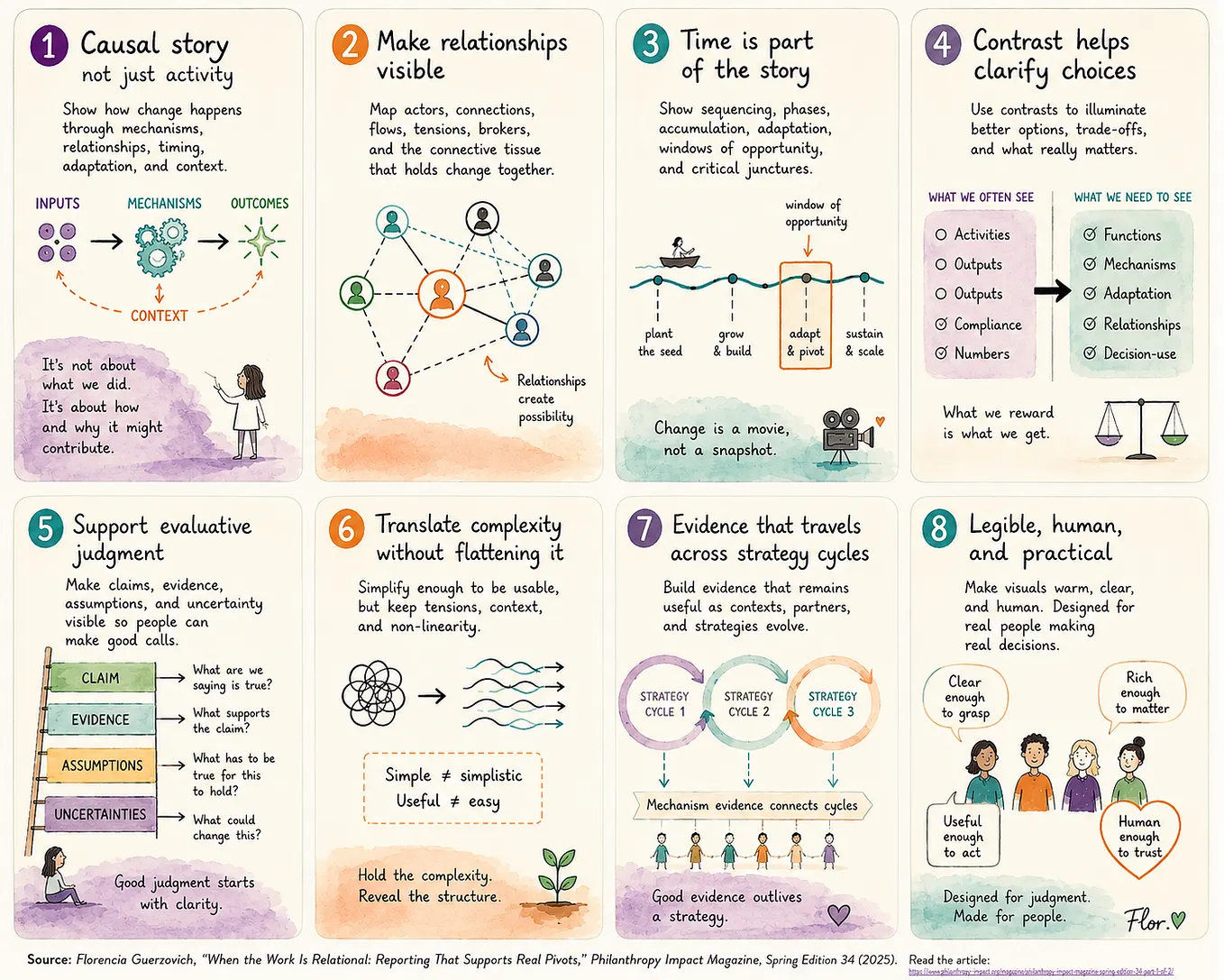
I had encountered the same underlying problem at a different level in portfolio monitoring, learning and evaluation. We are often trying to make sense of evidence across projects that differ substantially in geography, sector, partners and intervention form. Treating each project as wholly unique makes portfolio-level learning difficult. But aggregating by activity, output or formal model can flatten precisely the differences that matter.
One way through is to concentrate scarce evaluative resources on priority causal hotspots within a process that matters across the portfolio — for example, how relationships support learning and uptake beyond an initial intervention site. The forms and specific outcomes can differ while still generating evidence that can be compared and, eventually, aggregated across projects and over time. This portfolio work illustrates that meaningful comparison for portfolio-level learning does not require identical interventions or identical outcomes. It requires being explicit about what dimension of causal work is comparable. Conversely, failing to make those dimensions visible can create important blind spots for decision-making (for an example, here).
Not all of the portfolio-level analysis I have done along these lines has been published. But I have encountered versions of the same problem in other portfolios since — including in the work in Nepal, where I kept returning to the question of what could meaningfully be compared and aggregated across very different problems, forms of action and sites. More on that soon.
But in Monitoring, Evaluation and Learning, the problem often becomes harder to locate. Particularly in complex governance, advocacy, systems and portfolio work, the causal work we need to understand may not map neatly onto a single intervention, component or actor. It can be distributed across relationships, informal practices, workarounds and sequences of action that cut across formal boundaries. Sometimes we only see the relevant function by comparing across cases: noticing that very different arrangements are doing sufficiently similar work — or, conversely, that apparently similar arrangements are producing effects through quite different causal processes.
Ask whether a program preserved a known function while adapting its form may not be the task. We may also need to work out from the evidence which functions were actually consequential, which are meaningfully comparable across cases, and where that equivalence stops.
We may discover that the activity formally described as central was not doing the consequential work — as we illustrate in chapter 3 here . We may find that different arrangements performed a sufficiently similar function to make comparison useful — much like miso and sea salt might. And we may find that the apparent equivalence holds for one part of a causal pathway but stops at the next.
Fidelity cannot simply mean identifying a fixed list of core functions and protecting them forever.
Sometimes the more important question is:
Which causal functions and relationships still matter here? Which need to be preserved, recreated or redistributed — and which no longer should?
The original intervention may contain an accident of context
This distinction matters because what looks essential in the original model may partly be an accident of the environment in which it first worked. A charismatic program leader may have performed brokerage that was never written into the model. A government counterpart may have opened doors that later implementers assumed were structurally available. A donor may have provided enough flexible funding to absorb experimentation that subsequent versions cannot afford. An informal relationship may have connected an ostensibly formal process to the people who could actually act. Conversely, a highly visible component may have contributed very little to the result.
If we replicate the intervention before understanding this causal architecture, we may preserve the ceremonial pieces and lose the consequential ones.
This is particularly easy to do with relational work because relationships often disappear into activity language.
“Convened stakeholders.”
“Provided technical assistance.”
“Supported dialogue.”
“Built capacity.”
Each phrase can conceal very different causal functions. Did the convening create new relationships? Legitimate an existing coalition? Translate disagreement? Provide political cover? Route information? Maintain a dormant network until an opportunity emerged? Those differences matter if we want to know what must travel.
Fidelity to function is not permission to change anything
There is an obvious danger here. Once we say that form can vary, adaptation can become a convenient explanation for almost anything — including throwing spaghetti at the wall. Every deviation becomes “contextualization.” Every omitted component becomes “non-essential.” Every disappointing outcome gets blamed on complexity.
That is not what I mean.

Fidelity to function, if it is going to support meaningful comparison and aggregation, requires more causal discipline, not less. Reflecting back on my practice, explicitly or implicitly, I suspect I often answer a series of questions (the list is a work in progress).
1. What is actually blocked?
What is the problem? Do not focus on the activity. Is information failing to travel? Are actors unable to coordinate? Is technically credible evidence politically unusable? Is authority fragmented? Do relationships disappear every time staff rotate? Are people unwilling to take a risk that the intervention assumes they will take? If we cannot identify the blockage, “function” easily becomes another vague word.
2. What work needs to happen?
Express the function as something concrete enough to investigate. We should be able to see it at work in the real world. Translate. Route. Authorize. Connect. Protect. Remember. Coordinate. Legitimate. Create feedback. “Build capacity” is often too broad. “Strengthen collaboration” may describe an aspiration rather than causal work. The function should help us ask what would actually be different if it were being performed. This is partly why I have spent so much time trying to identify how you see invisible weaving, especially of the effective kind.
3. What form is performing that work now?
A committee? An adviser? A grant? A database? A community intermediary? A WhatsApp group? A sequence of private conversations before a public meeting? The answer, in my experience with complex portfolios, often reveals that the formal intervention is only one of several relevant forms. And once you see it this way, the ability to spot patterns, to find meaningful ways to make contextualized comparisons changes radically.
4. How is that form expected to produce an effect?
Repeated interaction may reduce the perceived risk of cooperation. Trusted translation may turn an accusatory demand into a proposal that an official can act upon without losing face. A public commitment may make inaction more costly. An intermediary may connect actors who each hold only one part of a problem. The label on the intervention generally tells us very little about the mechanism.
5. What has changed since this last worked?
Here Mechanisms Have Moods (Post 3) matters. The relevant mechanism may depend on conditions that have shifted. Has formal authority moved? Has the political mood changed? Has trust eroded? Has an election changed the incentives of a key actor? Has the intermediary lost legitimacy? Has the problem itself moved from local to provincial or national jurisdiction? Has the baseline shifted? What worked before may still perform a useful function — but through a different mechanism, at a different scale or only up to a different point in the pathway. Adaptation is therefore not necessarily a one-off redesign. It can be an ongoing response to a context that itself continues to change.
6. What evidence would show that the function is still being performed?
Forms are easy to count. The meeting happened. The adviser was hired. The platform launched. Five hundred people registered. Function requires different evidence. Did information reach someone who could use it? Was disagreement translated into a form that made action possible? Did an actor behave differently afterward? Did a relationship survive a transition? Did the arrangement create a routine that others could carry forward? Did people who were previously excluded gain access — or did the adaptation simply make their exclusion harder to see? The relevant evidence will depend on the causal claim.
7. How far does the continuity actually travel?
This requires discipline. Preserving one function does not mean preserving an entire causal pathway. Information may still travel without influencing a decision. A decision may change without producing the capacity to implement it. A practice may be taken up without becoming institutionalized. A network may reactivate during a crisis without becoming permanent infrastructure. Each additional claim crosses another evidentiary threshold.
Get Florencia Guerzovich’s stories in your inbox
Join Medium for free to get updates from this writer.
So adaptation needs a stopping rule:
Claim continuity only as far as the evidence shows that the relevant causal work continues.
Beyond that point, we are making a different claim and need different evidence. The relational and causal rubric that Alix Wadeson and I put together provides a useful example for turning this intuition into a measurable indicator that can be included in a logframe.
8. Is this still the function we should preserve?
There is one more, related, question that discussions of fidelity (and sustainability) can sometimes underplay. Not every function should survive indefinitely.
Programs and portfolios change because problems change. A broker who was essential while formal institutions were weak may become less useful — or even obstructive — once authority becomes clearer. A parallel community structure created to compensate for an institutional gap may eventually need to disappear rather than become permanent. A donor-supported learning process may need to migrate into another organization or lose its original shape altogether. The objective is to understand what work still needs doing, by whom, and through what arrangement now rather than keep a successful intervention or structure alive forever. The same is true of organizations — a version of this problem I return to below.
Organizations are forms
I want to extend this reasoning beyond programs. Organizations themselves can also be understood, for this purpose, as forms through which functions are performed. They hold relationships, knowledge, legitimacy, convening power, administrative infrastructure, access to particular communities — and sometimes capabilities that become visible only when the organization changes or disappears.
This question has become increasingly concrete in my collaboration with Civic Strength Partners, including recent conversations at CADF about civil society resilience and organizational transitions. If an organization restructures, merges, closes or changes purpose, what exactly are we trying to sustain? The legal entity? The brand? The team? Particular programs? Relationships? Knowledge? Access to communities? Convening capacity? A role the organization plays in a wider ecosystem?
Thinking in functions does not answer those questions automatically. But it gives us a different way to ask them: which functions still matter as the civic ecosystem changes? Which depend on the current organizational form? Which could travel? Which relationships or capabilities would be difficult to recreate elsewhere? And which functions may no longer justify preserving the organizational structure that currently carries them?
Monitoring the work, not only the container
Once we distinguish the work from the container, this also changes what monitoring needs to notice.
Most monitoring systems privilege forms because forms are visible. Activities delivered. Participants reached. Tools produced. Meetings held. Budgets spent. Reports written. Those familiar measures can remain reassuringly positive while the causal process erodes. This is also why organizational reporting can be misleading.
I have argued elsewhere that funders can have extensive reporting and still lack the information they need when strategy changes. Reporting can tell us that an organization has a governance body, is busy and compliant without showing whether the functions and relationships that made its work strategically valuable are still holding.
Continuity can survive a change in form
There is also a temporal version of the problem. As I have argued in writing about adaptive management across project cycles, Monitoring, Evaluation and Learning often gives us snapshots when we need moving pictures. A later intervention may build on an earlier one without replicating it. A dialogue may leave behind relationships that people reactivate during a crisis. An informal intermediary may later move inside government. A project-supported practice may migrate into a routine, budget or network whose connection to the original intervention becomes hard to see. An organization may close while some of its relationships, knowledge or ecosystem functions migrate elsewhere.
I am encountering a version of this in the research on young women’s education-to-work trajectories in Southeast Asia that I mentioned in Post 2. Looking across successive phases of support, the more useful question is not simply whether the original model persisted, but what functions and relationships travelled, changed form, or became newly important as women approached different transition points. We are still testing that account against the evidence.
Or the opposite can happen: the formal activity or organizational structure survives long after the function that made it valuable has disappeared.
That gives us two useful cautions:
Continuity of form is weak evidence of continuity of function.
And:
Discontinuity of form is weak evidence that the function has been lost.
Understanding what actually travelled requires following the causal work through time.
This may sound like a question for evaluation geeks, but it can be a strategic one too.
Take current debates about the future of civic space and the institutions that support it. As civic space, funding and institutional arrangements shift, many colleagues are grappling not simply with which organizations should survive, but with what functions civic ecosystems will continue to need, which may need new carriers, and who is well placed to perform them.
Much of that debate still tends to be organized around familiar organizational categories. Jean Scrimgeour argues that we should think of “intermediation” as a verb rather than “intermediaries” as nouns. That is essentially the same analytical move: shift attention from the organizational form to the work being performed, and then ask which actors or organizational arrangements can carry that work under changing conditions. That shifts the strategic and the Monitoring, Evaluation and Learning question at the same time: what work will matter, who can credibly carry it, and what evidence would tell us that it is actually being performed?
Recipes still matter
None of this means we should throw away program models, protocols, theories, or recipes. Nosrat’s own work suggests a more generous view of recipes. They can carry experience, give newcomers a point of entry and prevent us from having to rediscover everything ourselves.
The same can be true of intervention manuals, theories of change, interview guides, monitoring frameworks, bodies of literature, and established practices. They can encode knowledge. They can protect some things from disappearing. They can give people somewhere to start. In fact, much of my work would be harder without drawing on a broad range of theoretical repertoires — that could be another post. Usually, they cannot by themselves tell us how well they were enacted, how they interacted with context, or whether the causal work that mattered before was being performed over time.
The problem is not the recipe by default. The problem is mistaking the recipe for the knowledge, judgment, quality of practice and conditions through which it was made to work.
What should stay the same?
Across these four posts, I have moved from cooking to a fairly abstract methodological question.
How can we learn across difference without pretending that difference disappears?
Functional equivalence helps us specify the causal job that makes comparison meaningful. Attention to mechanisms and context helps us understand why performing a similar function does not guarantee the same effect.
Fidelity to function then turns those insights toward action. But perhaps fidelity to function is still slightly too static. Sometimes the aim needs change.
Nosrat’s lesson is useful here because good cooks do not abandon structure. They learn what must remain sufficiently stable, what can be adjusted, and when “training wheels” are still useful. Monitoring, Evaluation and Learning in complex settings may need a similar balance.
Sometimes the form should remain. Sometimes it should change. Sometimes a function needs to be performed differently. And sometimes the evidence shows that the original function is no longer the relevant one. That applies to interventions, portfolios and organizations. Preserving value is not always the same thing as preserving the container that currently carries it.
None of that makes comparison impossible. It makes the terms of comparison more explicit. The task is to identify what is stable enough to compare, what variation is causally consequential, and how far the evidence allows the claim to travel.
And choice is the operative word — often, in practice, a process of arbitration. Adaptation is often described as flexibility, but flexibility only creates room to act. Someone still has to decide what to preserve, what to modify, which risks to accept, and which route is most likely to keep the relevant causal work intact. And that often means accepting trade-offs and letting some things go.
Those judgments may need to respond to emergence — the evaluative equivalent of tasting, smelling, noticing that something is changing, and adjusting accordingly. But that need not mean retreating from systematicity, comparison, or the search for patterns into “everything depends.”
Emergence can be incorporated into a more sophisticated causal proposition: what remained stable, what changed, why that variation mattered, and how far the evidence allows the explanation to travel.
That is something evaluation can examine — and use to support learning for decision-making.
Perhaps that is the discipline beneath adaptation: enough structure to accumulate knowledge across cases and over time; enough responsiveness to recognize when the causal conditions have changed; and enough evidence to distinguish a meaningful adaptation from simple variation.
Not copying what worked, not starting from zero every time, and not mistaking every variation for innovation or every surprise for emergence. It is learning what work matters, specifying the dimensions along which cases remain meaningfully comparable, and testing whether the evidence still supports the claims we are making for what changed and what endured.
Miso is not sea salt. But once we understand what the salt was doing, we become much better equipped to judge when the recipe should change — and when changing it would mean losing the dish.