Miso Is Salt Too (Part 1)

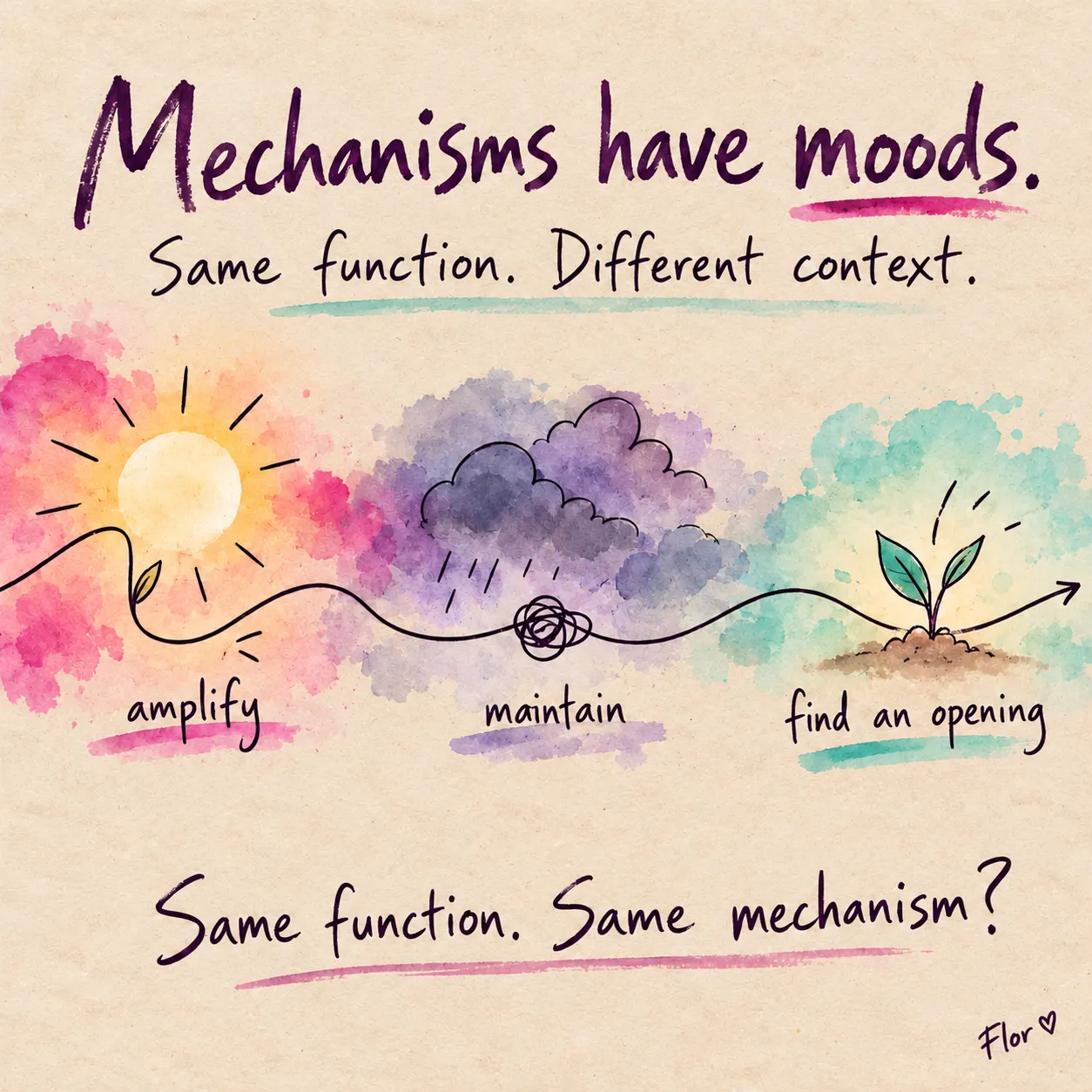
Different forms can sometimes perform similar causal work — in cooking and in evaluation. The challenge is learning to recognize when — and without pretending the differences disappear.

Several years ago, writing with Tom Aston and Alix Wadeson about how to learn across diverse portfolios, I said that we would return to the idea of functional equivalents.
We did not. At least, not directly.
I kept approaching the problem through other doors: mid-level theory, causal pathways, typologies, mechanisms, indicator architecture. But the basic puzzle remained.
How can we learn across interventions and contexts that look different without either flattening those differences or concluding that everything is too context-specific to compare or to understand as part of a whole?
A few weeks ago, I was talking about this issue with colleagues at The Asia Foundation in Kathmandu, as we explored how to learn about the threads and patterns in a complex portfolio’s 10 year trajectory across multiple sub-national sites, levels of government and thematic and sectoral focuses. My love of cooking and Samin Nosrat’s Salt Fat Acid Heat gave me a useful way back into the question.
Salt does not always look like salt
In the “Salt” episode of the Netflix series, Nosrat travels to Japan. Salt appears as sea salt, but also through soy sauce and miso. For “Acid” travel to Mexico and think of sour oranges, limes and salsas. The ingredients are materially and culturally different. They cannot simply be substituted measure for measure. Yet they can perform some related work within a dish.
That distinction — between what something looks like and what it does — is central to Nosrat’s way of teaching.
Her proposition is not simply that cooks should memorize four new rules. Salt, fat, acid and heat are more like a set of coordinates. They help people understand what is happening in the food, diagnose what is missing and decide what adjustment might help.
The point is to embrace our own sense of agency and develop judgment. Because doing so, that is exercising our critical thinking, equips us to develop enough confidence to substitute, adjust and cook with what is available
In an interview, Nosrat reflects on her cooking classes in a nuanced way. They involved repeated cycles of cooking, tasting and adjusting. But she doesn’t set up a strawman alternative or fully disregard recipes. She initially resisted including recipes in the book. Interestingly, Michael Pollan’s foreword to the book pushes the argument even harder, describing recipes as potentially “infantilizing” when they give instructions without helping the cook understand why.
Nosrat wanted students to understand how, why and when to use the four elements. She had learned by doing. When she had her aha moment about the four rules!, professional chefs told her that was obvious — they were doing it all along. And yet, the wisdom was absent from the recipes in those cookbooks chefs sent Nosrat to read early in her career!
But Nosrat also came to recognize that recipes can be useful “training wheels,” particularly when someone is beginning or entering an unfamiliar cuisine.
That balance matters.
A rule of thumb or principle is not a recipe. But a rule of thumb does not make recipes, tasting and smelling how the preparation is going, or the muscle memory we develop by experimenting time and time again unnecessary.
We have a recipe problem
In policy-making, development and philanthropy, we often begin with an intervention that appears to have worked somewhere:
- a community scorecard;
- a policy dialogue;
- a fellowship;
- a citizen committee;
- a learning network;
- a training curriculum;
- a digital platform.
We identify its visible components (“the package”), turn them into a model and ask whether someone else has implemented that model faithfully. Frankly, we often do the same with organizational forms — turn to checklists and health checks and forget to ask whether those shells are functioning in practice as the context shifts (more on organizations later in the series).
Many proponents of experimentation and complexity approaches, like Nosrat’s initial expectation, present their position as the polar opposite of packages, health checks, and the recipes associated with them. Sometimes this is zero-sum advocacy posture is useful. Others it is not.
Recipes also carry accumulated knowledge. They make expertise more accessible. They prevent people from starting from scratch. In this grey zone, they are training wheels “for the inspiration, context, and general guidance they offer, rather than by following them to the letter” — just like the recipes in the cookbook. If a recipe calls for spinach, but you have chard … switch it up, will say Nosrat. If you want that “cheesy” something in a Middle Eastern dish go for feta, but you’ll need to go for cuartirolo or something else in my mom’s Argentinean kitchen.
Coordinates should not pre-empt us from tasting, smelling, asking, and adjusting. An onion combined with different types and levels of heat can taste radically different— does charring over a flame make more sense than low heat mediated by a pan for this preparation in this setting?
Visible components (the onion) can also distract us from the causal work that made an intervention (picking, applying and testing the heat level) valuable (or flavorful) in the first place.
A policy dialogue may have mattered because it brought previously disconnected actors into the same room. Or because a trusted intermediary translated politically sensitive demands into administratively actionable proposals. Or because it gave a senior official political cover to authorize a decision. Or because it kept a relationship alive until conditions became more favorable. The meeting itself is not the explanation and should not be evaluated in a vacuum. It is a container in which one or several functions may — or may not — be performed. Elsewhere, similar work might happen through an embedded adviser, an informal network, a professional association, a recurring phone call or a respected local broker.
The forms differ. The causal job may be similar rather than an alternative.
This is not a search for four ingredients of social change
For me, the least useful lesson to draw from Salt Fat Acid Heat would be to invent four universal ingredients of effective evaluation or social change. That would turn a philosophy intended to develop judgment into one more portable framework to apply everywhere. The core principle underpinning it all — tasting and smelling questioning along the way to inform real time decisions — forgotten along the way.
Social interventions generally do not work like ingredients with stable properties. Their effects depend on meaning, power, authority, timing, relationships and history. People interpret interventions and respond to them. A formal committee may confer legitimacy in one place and signal political capture in another — context interacts with mechanisms, in social science. A public meeting may enable voice for some people and make participation riskier for others. It depends …. (more on this later in this post series, too).
The analogy is useful for a different reason. Nosrat shows that expertise involves seeing beyond the most familiar manifestation of something. Salt is not limited to white crystals. Acid is not limited to lemon juice or vinegar. The cook learns to recognize a function across multiple forms while remaining attentive to their different qualities and consequences.

There is a methodological cousin to this intuition. Research on complex interventions has argued that, in some circumstances, unction and process rather than ideantical components should be standardized across sites, allowing form to respond to local context.
Get Florencia Guerzovich’s stories in your inbox
Join Medium for free to get updates from this writer.
The language is different than the one used to think of the balance in an emulsion — which Nosrat also describes as a “temporary peace treaty between fat and water” that enables mayonnaise, butter, or vinaigrettes. The intuition is strikingly similar.
Rules of thumb do not erase situated knowledge
Another feature of Nosrat’s Netflix series is that she does not travel simply to demonstrate that her framework works everywhere.
She dialogues. She learns. She connects.
The series foregrounds soy sauce makers (pun intended, for those who watched the Netflix show😉), home cooks, and other people whose knowledge is rooted in particular ingredients, places and traditions. Nosrat uses her framework to help viewers notice patterns that travel the world over, but she does not present those patterns as a substitute for what local experts know. She reconciles them.
That is also important for research and evaluation.
Recognizing that a trusted intermediary may perform a recurring function — translation, routing, authorization — does not tell us who can legitimately play that role in a specific setting.
It does not tell us:
- whose metaphorical language is being translated into whose;
- which knowledge becomes usable and which is filtered out;
- what forms of authority the intermediary carries;
- who trusts that person;
- or what happens when the relationship ends.
A framework — much like Nosrat’s — can help us know what to look for. It cannot relieve us of the responsibility to ask and think critically. Functions may travel more readily than recipes. But they still have to be understood in place and time.
From following instructions to developing judgment
In many complex settings, an analytical framework should not merely tell evaluators which template to complete, which interview question to repeat or which indicator to collect.
It should help us reason (and help our readers understand how we reason).
That includes learning to notice:
- where a causal process is blocked;
- what work an activity is actually performing;
- what evidence would distinguish a plausible explanation from a convenient story;
- which differences across cases matter;
- and when the original theory or method needs to be revised.
I have made a related argument about qualitative interviewing. In Beyond the Script, I argued that interview guides should support inquiry rather than kill curiosity. Preserving methodological rigor does not necessarily mean asking every person the same question in the same way. It may mean adapting the interaction while preserving the evidentiary purpose.
Recipes (or questionnaires) can be scaffolding. They should not become substitutes for agency and judgment. It’s really about tasting and smelling and questioning to inform decision-making.
A way back to an unfinished question
In Learning from consortia and portfolios: From cacophony to symphony, we were struggling with a practical problem.
Portfolios contain different interventions, actors, organizations, countries and causal pathways. Aggregating them indiscriminately creates misleading averages and laundry lists. Refusing rules of thumb, groupings and comparison altogether leaves funders and practitioners unable to identify patterns, outliers or gaps across their work.
We suggested that it might be possible to create meaningful groupings around “functional equivalents.” The post promised a follow-up. It took me a few years — and a cooking book — to work out what I wanted to say.
The key question is not:
Do these interventions look sufficiently alike?
It is:
Equivalent for what?
That question is where the metaphor becomes a methodological proposition.
In the next post, I turn from cooking philosophy to causal research and learning and evaluation: how functional equivalence can help us compare across difference without confusing similarity with sameness.
Miso is not sea salt.
But sometimes, to understand the dish, we need to recognize some of the work both can do.
More soon.