What Happens When Civil Society Asks for MEL — Even When Donors Don’t


When local organizations seek learning support on their own terms, funders can learn a great deal about the systems we’ve built.
Funders often assume that monitoring, evaluation, and learning (MEL) demand flows one way — from donors to grantees. But what happens when civil society organizations ask for MEL support on their own terms?
Earlier this year, the Latin American School for Community Lawyering and Legal Activism (ELAC) invited me to design and facilitate an introductory course on MEL. ELAC is an innovative regional platform that connects and strengthens activists and organizations advancing empoderamiento jurídico comunitario — community legal empowerment — across Latin America.
The course was part of ELAC Impulsa, a program offering tailored institutional-strengthening support to small and mid-sized groups that help historically marginalized communities use and transform the law for social justice. Impulsa blends structured courses with workshops designed in response to participants’ own priorities.
When the ELAC team asked which competencies organizations most wanted to develop, several prioritized MEL. Their interest wasn’t donor-driven; no one was required to take the course. They asked for it voluntarily.
That demand stood out. Across the region, MEL is still experienced mainly as a compliance exercise — a way to satisfy donor reporting rather than a resource for internal decision-making or collective learning.
The paradox of confidence and demand
Before the course began, forty-five participants self-assessed their confidence with familiar MEL tools — logframes, indicators, and method selection. Most reported feeling comfortable.
That confidence coexisted with a strong demand for help. The issue, it turned out, was not lack of exposure to MEL but misalignment between the tools people knew and the questions their organizations needed to answer.
Participants had been trained in a narrow set of descriptive, before-and-after techniques. They were confident in those tools but recognized their limits for guiding real-world choices. As one ELAC colleague put it, “They don’t know what they don’t know.”
Expanding the repertoire — and the agency behind it
The course was designed for MEL amateur cooks, not Cordon Bleu chefs, borrowing Chris Lysy’s metaphor. Rather than seeking mastery of every technique, these “cooks” already improvise with what they have in a civic ecosystem with limited financial resources. The goal was to spark curiosity, help them expand their pantry and think critically how to best pick and use their ingredients.
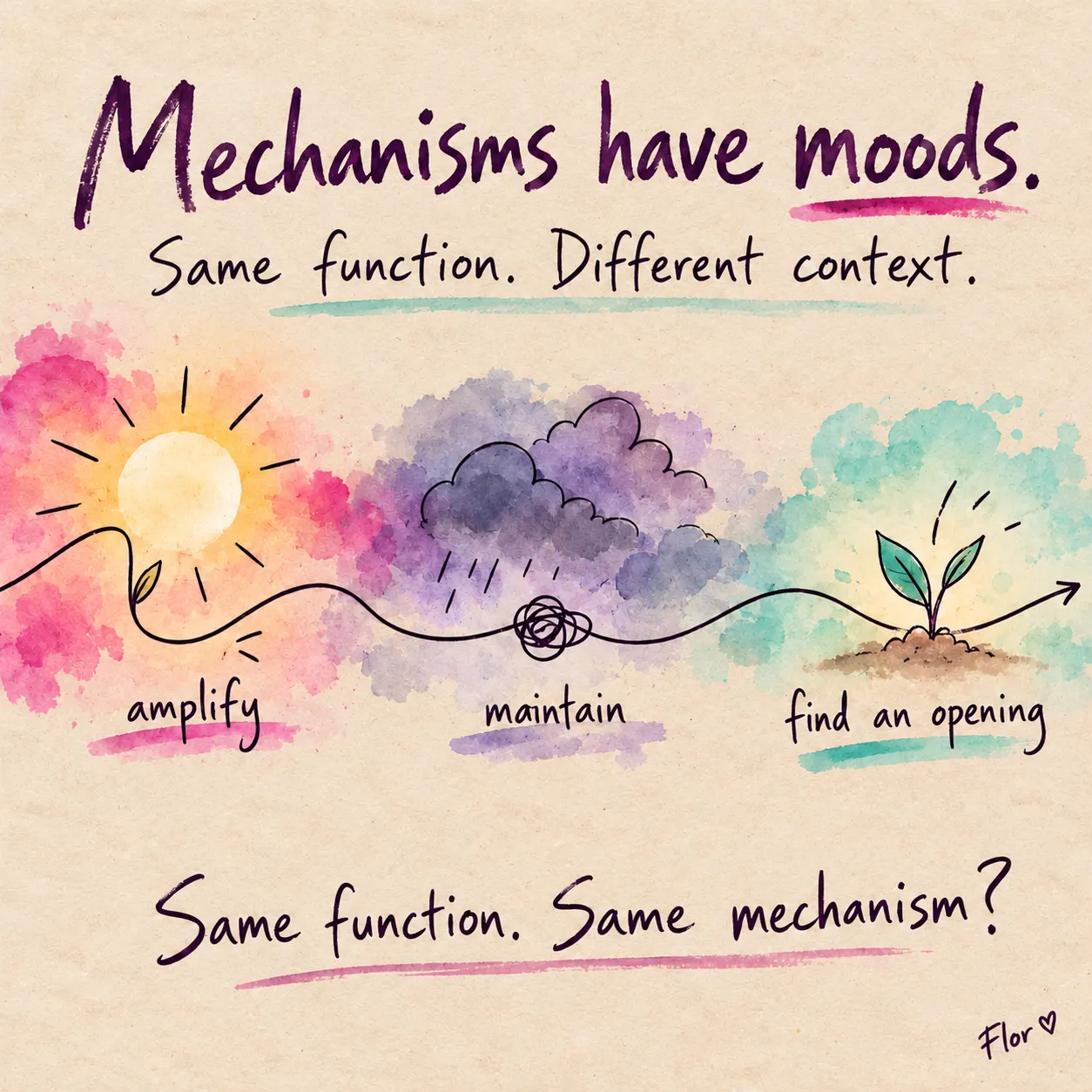
Through playful exercises and relatable metaphors, participants were introduced to a “cast” of evaluation methods, each with its own personality. The activity helped demystify jargon and created a shared language to discuss when different approaches make sense.
One participant captured the shift succinctly: “I learned that there’s more to M&E than pre- and post-description.” Others joined in.
This revealed that organizations weren’t asking for more templates or stricter routines. They weren’t asking for the latest, fanciest MEL trend. Learning about something interesting or inspiring for learning’s sake was not in the wishlist, either. They wanted a broader, more intelligible toolkit — and the criteria and agency to choose methods aligned with purpose and constraint.
Why the gap persists
Latin America has a vibrant evaluation community and strong academic training in research methods. Yet few examples seem to connect that regional expertise to the MEL realities of civic and social-change organizations represented by that group in the virtual classroom.
As highlighted during the ReLAC Conference, there remains limited use of approaches that help critically unpack complexity — such as process tracing, realist evaluation, MEL for thinking and working politically, or systems-based inquiry — in the Latin American MEL ecosystem. The growing interest in participatory approaches is perhaps an exception, but significant gaps remain around other evaluative methods and approaches. The gap is not purely technical: it reflects uneven incentives, access to resources, and translation between global professional evaluation circles and local practice.
The result is a fragmented landscape. A few well-resourced actors experiment with fit-for-purpose MEL approaches, while many organizations remain confined to tools designed for donor reporting, one project at a time. Knowledge rarely travels across those boundaries.
The missing middle in organizational learning
As Impulsa participants reflected on their realities and engaged with new concepts, they described patterns common across the sector: project-level MEL that fails to connect across programs in an organization, insights leadership rarely uses, and systems that collapse when key staff move on.
Get Florencia Guerzovich’s stories in your inbox
Join Medium for free to get updates from this writer.
These weaknesses are often attributed to donor incentives, but participants surfaced a deeper challenge: a missing layer of double-loop learning — asking not only “Are we doing things right?” but “Are we doing the right things, in the right way?”
Double-loop reflection concerns the causal assumptions, relationships, and norms that shape an organization’s choices. Many civic groups are adept at single-loop learning (adjusting activities), and in rights-based organizations, leadership often engages in triple-loop learning (revisiting identity and values). What was missing in participants’ accounts was the middle layer — the connective space that links staff and volunteers’ everyday experience to leadership’s strategic and normative purpose.
Without that connective tissue, implementing teams and leaders inhabit separate learning worlds. Even intentional reflection can unintentionally widen the gap.
By the final session, participants’ questions had shifted away from indicators toward collective MEL across organizations and alliances. For many, the MEL of coalitions and networks represents the most urgent gap to close with double-loop learning.
Their questions echo those raised in portfolio-level and systems MEL “global” debates in philanthropy:
- Are we adding more than the sum of the parts?
- Who holds MEL when outcomes depend on multiple actors?
- How can collective MEL for action be organized and sustained?
- How can it influence leadership to act beyond business as usual?
These questions about the MEL of configurations (with a strong focus on how to get better at it) are rarely articulated — or supported — in Latin America for and by Latin Americans.
Implications for funders
Latin American donors are facing a growing number of demands in a civic sector that is undergoing significant change. A recent Civic House study maps the sustainability challenges of an ecosystem navigating between professionalization and fragility. Like the course participants, the study concludes that building coalitions and strategic alliances is key to advancing financial sustainability and defending civic space in the region.
However, participants raised an important warning: without critical thinking, those coalition-building efforts can lose internal cohesion, direction and effectiveness.
The study also recommends promoting adaptive models in the face of changing contexts and developing new fundraising strategies. Both shifts depend on — and are strengthened by MEL processes and products that generate data and narratives to support fundraising efforts and enable adaptation based on analysis rather than on improvisation only.
For that reason, the recommendations could be complemented with one more: invest in new forms of MEL and MEL upskilling.
This experience offers several insights for funders and intermediaries seeking to strengthen MEL capacity equitably and sustainably:
1. Invest in translation — conceptual, not just linguistic.
Global systems- and portfolio-MEL resources should be connected and adapted into intuitive, context-relevant formats: methods that live in the neighboring university, local stories, and examples that resonate with, but also stretch, the lived experience of civic practitioners.
2. Design for existing competence, but expand agency.
Recognizing local expertise is essential, so is addressing the “paradox of confidence and demand” — helping practitioners see beyond the tools and approaches they know and make informed, critical choices.
3. Create connective learning infrastructure.
The missing double-loop layer can be strengthened through intentional investments that bridge frontline experience and big-picture reflection — within organizations and across alliances.
4. Revisit MEL architecture and incentives.
When MEL focuses on configurations of programs within organizations — or networks of organizations within a coalition — rather than on isolated compliance tasks, it can better capture how actors contribute collectively to shared outcomes.
Closing reflection
At its best, MEL can be the stitching that holds collective action together. Today, those threads are uneven — dense in some places, frayed in others. Reweaving them will take funders and leaders willing to support not just better data, but the conversations, relationships, and reflection that challenge assumptions to turn data into shared understanding.
Originally published in Spanish: https://escueladeactivistas.org/project/mel/