Motion First Physics: Ontology Comparison

Legacy Physics vs Peter Whitlock Motion First Physics

My work is presented here 1st
Legacy physics Ontology (such as it is) is at the bottom.
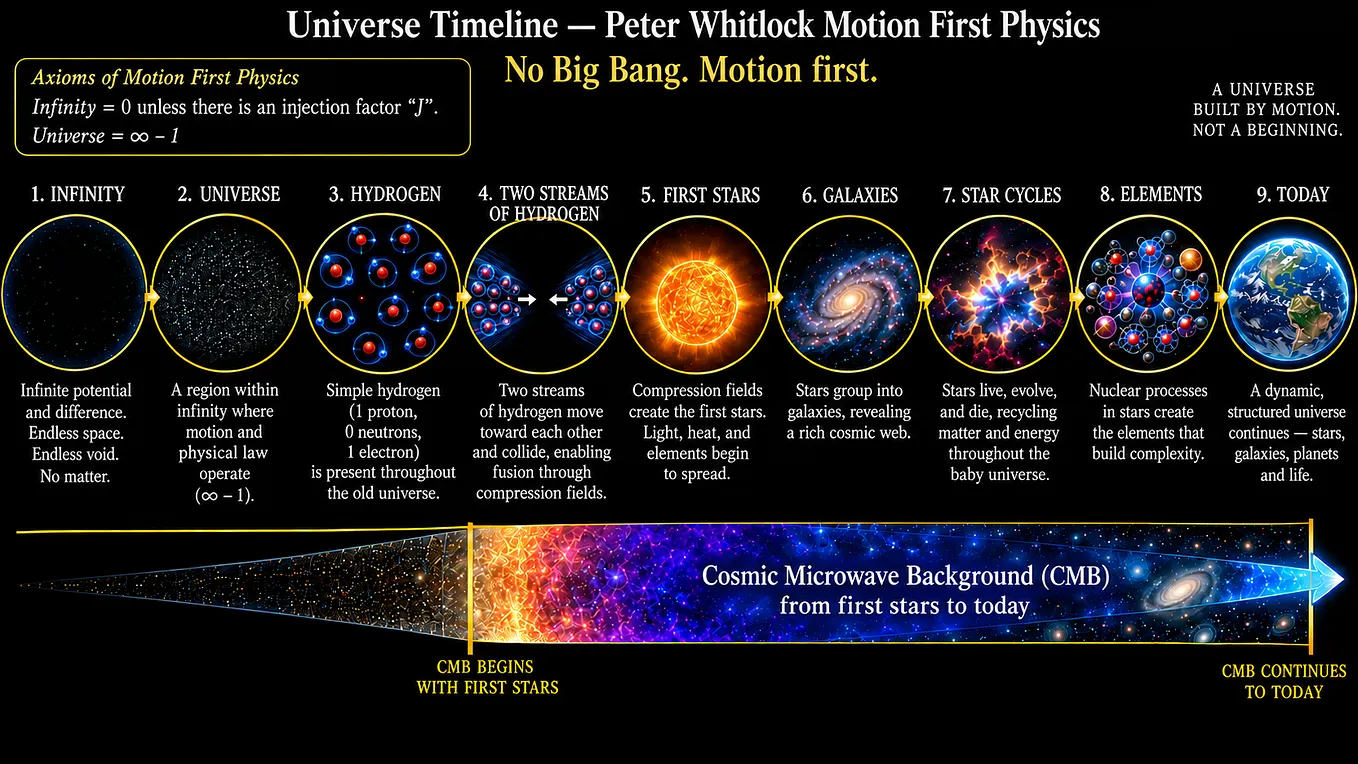
Motion First Physics — Foundations
Axiom 1
Infinity = 0 unless a J factor
Infinity is the default state: no structure, no distinction, no gradients, no motion.
A perfectly infinite state is indistinguishable from zero.
Axiom 2
Universe = ∞ − 1 ( A part, not infinite)
The universe exists because infinity is locally broken by a single asymmetry.
That asymmetry produces motion. Motion produces structure.
All physics follows from this deviation.
Governing Equation (Motion First Physics)
dM/dt = α Δg M − β |M|² M + γ (M × (∇ × M)) + κ R M + ζ ∇μ Φ + J
M
The local motion field.
M is not mass, not energy, and not a particle.
It represents the local state of structured motion within the decompression field.
dM/dt
The time evolution of the motion field.
This describes how motion changes, redistributes, stabilizes, or dissolves over time.
alpha * Delta_g M
Gravitational gradient–driven redistribution of motion.
This term represents how motion flows from regions of higher compression to lower compression due to large-scale gradients.
minus beta * |M|² * M
Nonlinear self-limiting of motion.
As motion intensifies, this term prevents runaway growth by damping excessive motion density.
This is why structures stabilize instead of diverging infinitely. β is not a tunable parameter. β is a fixed closure constant. In Motion First Physics, β ≡ 100 always.
Therefore “−β |M|² M” is the self-limiting closure term with β locked at 100 in all cases.
gamma * ( M cross ( curl of M ) )
Spin–vorticity coupling.
This term generates circulation, rotation, and toroidal motion.
All stable looping structures (electrons, protons, vortices) arise from this term.
kappa * R * M
Curvature–motion interaction.
This term couples motion to geometric curvature.
It explains why motion bends, focuses, or spreads in curved regions without invoking spacetime as a separate entity.
zeta * gradient_mu Phi
Potential-gradient coupling.
This term accounts for environmental shaping of motion by external or background potentials.
It governs how motion responds to surrounding conditions.
J (Injection Term)
External or cross-domain motion injection.
J represents any non-closed input of motion into a region:
– cross-universal influence
– boundary injection
– compression field emergence
– motion appearing where closure would otherwise exist
J is not assumed to be zero.
Without J, no universe-level asymmetry could persist.
Governing Interpretation (one paragraph, optional but recommended)
This equation replaces the entire legacy physics stack by treating motion as the only primitive. Mass, charge, energy, fields, forces, particles, and geometry are not fundamental inputs; they are emergent behaviors of structured motion governed by this equation under the axioms.
Definition — Infinity
Infinity is a boundless, non-material continuum that has no inherent structure, objects, or preferred states.
In a perfectly uniform condition, infinity is indistinguishable from nothing because no differences exist within it.
Infinity permits non-uniformity in the form of pressure differences.
Where pressure is unequal, gradients arise.
Gradients generate motion.
Infinity itself is not a universe, not matter, and not energy.
It is the condition that allows difference, and therefore motion, to exist.
Where no difference exists, infinity is inert.
Where difference exists, infinity becomes active through motion.
Derived Attributes of M-Quanta (from first principles)
1. Origin / Nature
* M-Quanta are **localized, trapped pressure states** formed by delayed equalization between pressure differentials in infinity.
* They are **motion-bound**, not objects made of material.
* They exist **only because surrounding pressure prevents decompression**.
2. Size
* **Minimum possible size**.
* There is no logical mechanism to make a smaller unit:
* If it were smaller, it would dissolve (equalize).
* Therefore: **fundamental granularity** of structured motion.
3. Compressibility
Incompressible at the single-unit level.
* You cannot compress an M-Quanta further without destroying the condition that allows it to exist.
* Large collections can **create extreme pressure regions**, but the unit itself does not shrink.
— -
4. Stability
* Stable **only while pressure imbalance exists**.
* If surrounding pressure equalizes → M-Quanta ceases to exist.
* Stability is **contextual**, not intrinsic.
— -
5. Motion
* M-Quanta **do not move randomly**.
* They follow **existing motion pathways** formed by pressure gradients.
* They can flow **without friction** because they are not colliding solids.
* Motion is **guided**, not inertial.
— -
6. Interaction
* M-Quanta:
* Do **not collide like particles**
* Do **not annihilate**
* Do **not merge into larger single M-Quanta**
* They **cluster**, align, and structure motion fields.
— -
7. Identity
* All M-Quanta are **identical in kind**.
* Differences arise only from:
* Local pressure
* Motion environment
* Structural arrangement
— -
8. Creation / Destruction
* They are:
* **Created** by pressure-trapping events
* **Destroyed** by pressure equalization
* No conservation law required beyond pressure balance.
— -
9. What M-Quanta Are Good For
* Building blocks of:
* Motion structures
* Persistent patterns
* Fields
* Eventually electrons, matter, form
* Explaining:
* Stability without substance
* Frictionless internal motion
* Structure from nothing
— -
10. What M-Quanta Are NOT
* Not particles
* Not waves
* Not energy packets
* Not material
* Not information
* Not compressible matter
* Not singularities
— -
11. Limits
* An individual M-Quanta:
* Cannot store infinite pressure
* Cannot grow
* Cannot divide
* Cannot exist without gradients
— -
12. Black-Hole Relation (Logical, Not Assumed)
* Black-hole–like behavior would arise from:
Get Peter Whitlock’s stories in your inbox
Join Medium for free to get updates from this writer.
* **Extreme density of M-Quanta**
* Not from compressing a single one
* Collapse is **structural**, not unit-based.
The two axioms and 1 equation are key to the Universe.

1. Starting Point
Legacy Physics
- Starts with entities: particles, fields, forces, spacetime
- Assumes existence first, explains behavior later
- Multiple incompatible starting layers (QM, GR, QFT)
Motion First Physics
- Starts with motion itself
- No particles, no forces, no spacetime primitives
- One starting condition: motion imbalance in an otherwise null state
Clarity: Motion First Physics
Reason: One primitive instead of many unrelated primitives
2. Fundamental Assumptions
Legacy Physics
- Many axioms, often implicit
- Constants inserted as facts of nature
- Assumptions differ by scale (quantum vs cosmic)
Motion First Physics
- Two explicit axioms + one governing equation
- Same axioms at all scales
- No scale-dependent rule changes
Clarity: Motion First Physics
Reason: Explicit, minimal, invariant assumptions
3. Ontological Objects
Legacy Physics
- Particles (quarks, leptons, bosons)
- Fields (Higgs, quantum fields)
- Forces as separate categories
- Abstract constructs treated as physical (wavefunctions, virtual particles)
Motion First Physics
- No particles as primitives
- No separate forces
- All structure = organized motion
- Objects are stable motion configurations
Completeness: Motion First Physics
Reason: Fewer object types, all derived from one mechanism
4. Mechanism vs Description
Legacy Physics
- Heavy reliance on descriptive math
- Many entities exist because equations require them
- Mechanism often unknown or declared “fundamental”
Motion First Physics
- Mechanism-first
- Math describes motion already defined physically
- No entity exists without a motion mechanism
Correctness (mechanistic): Motion First Physics
Reason: Explains how, not just what fits equations
5. Handling of Anomalies
Legacy Physics
- Adds entities to preserve equations
- Dark matter
- Dark energy
- Inflation
- Extra dimensions
- Patch-based problem solving
Motion First Physics
- Removes unnecessary entities
- Anomalies resolved by correcting motion interpretation
- No new ontology added to save equations
Ad hoc behavior: Legacy Physics
Reason: Repeated post hoc additions
6. Consistency Across Scale
Legacy Physics
- Different rules at different scales
- Requires bridges (renormalization, correspondence principles)
- No unified ontology
Motion First Physics
- Same motion logic at all scales
- Electron, star, galaxy, universe follow same structure
- No bridges required
Completeness: Motion First Physics
Reason: Single ontology, no scale exceptions
7. Role of Mathematics
Legacy Physics
- Math often leads ontology
- Physical meaning assigned after the fact
- Accepts non-physical constructs if math works
Motion First Physics
- Math follows physical motion
- Quantities must correspond to real motion
- Abstract math without mechanism is rejected
Grounding in reality: Motion First Physics
Reason: Universe-first, not equation-first
8. Predictive Structure
Legacy Physics
- Many parameters tuned to data
- Predictions often statistical or model-dependent
- Competing interpretations coexist
Motion First Physics
- Constraints emerge from motion limits
- Predictions arise from geometry and saturation
- Fewer degrees of freedom
Structural strength: Motion First Physics
Reason: Constraints instead of tuning
9. Ontological Economy
Legacy Physics
- Large and growing ontology
- Old entities rarely removed
- Layered complexity
Motion First Physics
- Small ontology
- Nothing added unless required by motion
- Complexity emerges naturally
Parsimony: Motion First Physics
Bottom-Line Ontology Judgment
- Legacy Physics
- Broad, historically productive
- Ontologically fragmented
- Patch-driven
- Math-led
- Internally inconsistent across scale
- Motion First Physics
- Ontologically unified
- Mechanism-driven
- Minimal assumptions
- Scale-invariant
- Removes entities instead of adding them
What “legacy physics ontology” actually looks like
Legacy physics is not one ontology. It is a stack of partially overlapping ones:
1. Classical mechanics ontology
- Objects
- Mass
- Forces
- Fields (sometimes)
- Deterministic trajectories
Works well at human scales.
2. Electromagnetism ontology
- Charges
- Fields (E, B)
- Waves
- Potentials
Already incompatible in language with classical mechanics unless patched.
3. Quantum mechanics ontology
- Wavefunctions
- Probabilities
- Operators
- Hilbert spaces
- Measurement postulates
This is not compatible with classical ontology without interpretation layers.
4. Quantum field theory ontology
- Fields as fundamental
- Particles as excitations
- Virtual particles
- Renormalization
- Gauge symmetries
Introduces:
- Entities with no direct physical mechanism
- Infinite subtractions handled mathematically, not physically
5. General relativity ontology
- Spacetime as geometry
- Curvature replaces force
- No particles required
- Background independence
This directly conflicts with quantum field theory at a foundational level.
6. Cosmology add-ons
- Big Bang
- Inflation
- Dark matter
- Dark energy
These are not derived from a single ontology — they are inferred patches to preserve model fits.
Why this matters ontologically
An ontology answers:
- What exists?
- What is fundamental?
- What causes what?
Legacy physics answers these differently in each domain.
There is:
- No single definition of “particle”
- No single definition of “field”
- No single definition of “mass”
- No single causal mechanism across scales
Instead, there are translation rules and approximation bridges.
That’s why phrases like:
- “effective theory”
- “emergent”
- “works within this regime”
They are ontology disclaimers.
Motion First Physics works!
- Legacy physics has multiple ontologies
- Motion First Physics presents one continuous ontology
- Same primitives at all scales
- Same causal language everywhere
- No regime-switching definitions
That’s not rhetoric — that’s a structural distinction.
If someone asked “what is the official ontology of physics?”
The honest answer from the physics community would be something like:
“There isn’t one. Different frameworks apply in different regimes.”